
Foot Lesions in Dogs: What Caused Gemma’s Sore Foot?
When assessing your limping dog, don’t forget to check for foot lesions or injuries. A sore foot can cause substantial lameness.
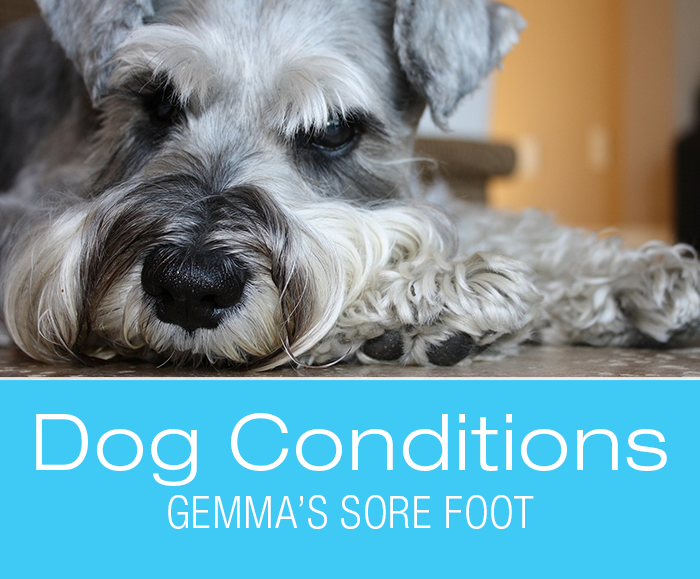
While joint and muscle injuries are common, you would be surprised at the degree of lameness foot lesions, or injuries can cause in your dog.
When Jasmine, who was a tough girl, had an infection on her foot, you would barely notice a problem, She would favor the leg just slightly, and usually only during the trot. Cookie, who is a sensitive, delicate creature, might not use the leg at all if there is anything wrong with it. That doesn’t mean Cookie didn’t want to run and play. But she would do so on three legs.
Gemma did not limp at all.
Her mom found her foot lesion because Gemma was licking her foot incessantly through the night. It was at the bottom of the foot right beside the plantar paw pad, and it looked swollen, angry, and infected.
When I see a foot lesion like that, my brain goes to a foreign body first.
Gemma’s mom was wondering whether it could be a hot spot.
Dogs can get hot spots anywhere on the body. However, a hot spot is a purulent infection of the skin surface. This was an angry bump.

Other than its location, it looked a whole lot like the abscess Cookie had from a porcupine quill embedded deep between her toes.
Where Gemma lives, they frequently have problems with Foxtails.
Foxtails and grass seed awns can pose a serious danger to dogs.
Foxtails are designed to burrow–that is how they work their way into the soil. Their shape allows them to move forward but not backward–a great trick. However, they will do the same thing to your dog–work their way deeper and deeper into the tissue.
This is not a light matter–with a bit of bad luck, one tiny seed can cause serious injury or even kill your dog.
You can read up more on Foxtails at Preventive Vet’s article.
The dog paws are the second most common entry point for Foxtails.
If these grasses are prevalent where you live, check your dog for grass seed awns and brush their coat after every walk. You can still miss one even with the best effort. It might not be until your dog’s limping or excessive licking alerts you to a problem.
While Epsom salt soaks can help with many foot lesions, they won’t do any good with a grass awn because those buggers are not coming out on their own.
And that’s when you might find a soft, swollen lump like Gemma’s mom found. But because there was no visible entry, she didn’t suspect a Foxtail.
Gemma’s veterinarian, however, did.
The veterinarian examined Gemma’s lesion and decided to look for the grass awn and remove it surgically. However, they didn’t find any. Could it be that it fell out naturally but introduced an infection into the tissue?
Hopefully, that was the case and the awn hasn’t traveled deeper in the meantime. You can see below how far these things can travel.
Gemma came home with a bandaged foot and antibiotics. If that resolves her foot lesion for good, the foreign body is likely not there any more. If it keeps coming back, they might need to keep looking. Cookie’s abscess went away and came back three times before the veterinarian found the porcupine quill fragment and was able to get it out.
Related articles:
Symptoms to Watch for in Your Dog: What is that Limp?
Further reading:
How to Prevent Foxtail Injuries and Remove Foxtails From Your Dog