Acute Hind Leg Lameness in a Dog: Are you thinking knee injury—Our First Health-Related Heart Attack With Cookie
Do you think it is easy to figure out what is causing your dog’s lameness?
Sometimes it is. And sometimes you can easily fall into the assumption trap.
The most common cause of an acute hind leg lameness in a dog are knee injuries. These injuries are common in dogs. But that doesn’t mean that is the answer every time.
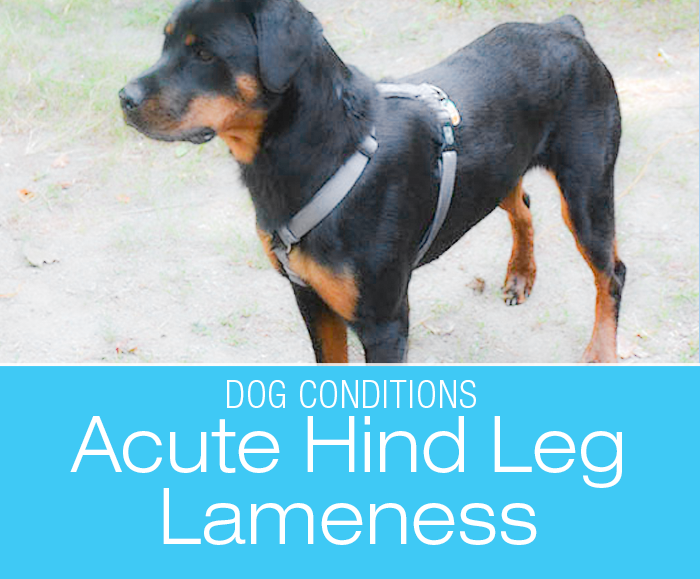
Cookie’s story
We went to meet Cookie on the way to Jasmine’s ranch. Since Cookie and our JD got along very well, we proceeded on our trip with an extra passenger.
Cookie seemed quite excited about her adventure, and not once she looked upset about being whisked away from all she knew.
The first day she spent so wound up, she didn’t slow down until dinner—there were so many things to explore.
The next day was spent in fun and games, though Cookie didn’t mind resting every now and then. The initial excitement wore off a little, it was hot, and she must have been exhausted from the first-day marathon.
Cookie’s limp
The third day started with walks and play and everybody had a great time. Then everybody settled down for a while to cool off.
When Cookie got up she was fully lame on her rear left leg. She wouldn’t put any weight on it at all. Our hearts sank. “You gotta be kidding,” we addressed God, omen or destiny, whoever would have been behind this.
What are we looking at?
It looked way too familiar—very much like a busted knee ligament. But Cookie is young, seemed healthy … and we didn’t get a chance to get her insured yet …
We examined the leg up and down.
There was some irritation in the foot, otherwise, we couldn’t put our finger on any other problem. But when Jasmine injured her cruciate, there was no swelling and no pain reaction to palpation we could elicit either.
There WAS the irritation on the foot. Hubby recalled that in the morning as she was running, she stopped suddenly and started fussing with it. Then she resumed play.
A little prick in a foot could cause this?
I’d certainly take an injured foot over an injured knee any day.
But I had a hard time buying that a foot injury, seen only as minor irritation between the pads, could result in such a complete lameness.
I remembered the two tumbles she took when she landed on the deck with more enthusiasm than control. You can imagine how worried I was.
As she remained lame through the day, we decided to cut the trip short, regardless of what this was.
Our house is well-equipped to accommodate a lame dog. And it would be easier to keep her calm, as well as see a vet.
Insect sting?
As I was packing up, I remembered that in the morning Cookie came for a visit in the trailer and I found something odd on the blanket. It was snotty, slimy, pouch-like thing; but not like any kind of snot I’ve seen come out of a dog before.
Then I recalled that once I got a wasp sting in my arm and as I instinctively slapped the wasp, similar looking slimy pouch-like thing remained on my arm too.
Perhaps it was a venom sac?
If it was, then I could buy the degree of lameness we were seeing. Hubby thought it might have been a sharp weed, but that just wouldn’t convince me. A wasp or bee sting would.
We did give Cookie some Benadryl, but it didn’t seem to have made much of a difference.
Knee injury?
What a start of her new life. We loaded Cookie into the bus and on the way back home we were.
There we a couple of things we felt were different between Cookie’s and Jasmine’s lameness. They both were fully lame on the leg, with the occasional toe-touch. Those are hallmark symptoms of a busted knee.
However, Cookie didn’t seem to have any problems with fully bending and extending the leg; there was no hesitation or resistance there. When sitting, Cookie sat normally, not with the injured leg kicked out to the side as Jasmine would. On the other hand, it seemed that Cookie didn’t want to put any pressure on the foot, even when sitting or laying down.
Those signs were somewhat hopeful, as they were different. And then there was the potential finding of the venom sac …
With our history, though, I wasn’t holding my breath. “And so it begins again,” I thought to myself with my stomach in knots.
At the veterinarian
As we returned, we immediately made an appointment with a local vet.
At least by then, Cookie started getting used to having only three legs to use because, at first, she seemed quite lost as to how to move about with one leg out of commission.
The vet examined her leg up and down, feeling everything and playing with the knee. She did not elicit a drawer sign or any other indication of a problem with the knee.
Not the knee after all?
Cookie’s foot looked somewhat swollen and the vet got pain response when playing with the toes. The conclusion was that the leg is fine and the problem is with the foot. That was a huge relief to us.
Cookie came home with Deramaxx and instructions that if the signs didn’t improve by the end of the week, they will need to surgically look for a foreign body in the foot.
We were still hoping that it might have been a sting. Other than the lameness and general swelling there was nothing that would look like an entry wound.
Cookie had to mostly rest, with just short potty walks.
A short-lived improvement
The next day she started walking normally on that foot, so we took her for a short walk as well. Things were looking good and we hoped that this might have been the end of it.
Since she was walking well, and really needed some exercise an entertainment, the next day we took her to the horse farm.
It was her first time there and you can imagine how excited she was. Playing with JD, running around, couldn’t settle down for a moment. She had a great time.
And then she went lame again.
A lump between toes
This time the foot looked very angry, with a lump that looked like an abscess now, and overall unhappy tissue. We called our vet whether he could see us that day and went from the farm straight to his office.
The toes were indeed very unhappy and sore. He squeezed a bunch of pus and Cookie limped out with a poultice bandage and antibiotics.
We had a follow-up appointment in two days to see whether or not an exploratory surgery was needed to find and remove the now likely foreign body.
The instructions were to keep the bandage dry. Fortunately, Cookie did not need the horrible cone of shame, because the bandage was a “no chew” product, in fact, had it written all over it.
“So she shouldn’t lick or chew this?” asked hubby.
“If she reads it,” replied the vet.
I guess Cookie did read it because she left it alone.
Two days of restricted activity and limping around later, the poultice came off. The foot looked much happier and it seemed that surgery was not warranted.
We were to do soaks in Epsom salt and keep an eye on it.
Finally an answer
Cookie was walking normally but the foot didn’t look to me the way I’d expected it to look–getting better. I kept looking kind of the same, still draining with a bump that almost looked like an interdigital cyst now.
So back to the vet.
He wasn’t happy with it either. Gave it a good squeeze and a bunch of pus and dead tissue came out. And then a tip of something became visible.
It was a porcupine quill.
Technically, Cookie should have been put under for that but because she’s been very good about it, the vet was able to pull it out right there on the exam table.
It was quite a good chunk but the without the tip.
The tip may or may not have remained in there. If after this the foot didn’t get better, surgery to find and remove it would be needed.
However, after this, the foot seemed to have been healing quickly and by the next appointment, it looked 90% healed.
We were so happy that our footsie trouble was over.
When we got Cookie we were told that she had a couple of encounters with a porcupine. Perhaps the piece of quill ended up in the foot as she was trying to paw them off her face. Perhaps she stepped on a quill fragment. Either way, the vet felt the toes very thoroughly and there was no indication that something should have been left in there.
Related articles:
Why Is My Dog Limping? Causes of Lameness in Dogs—Symptoms To Watch For In Your Dog
Common Limping Misdiagnoses in Dogs
Further reading:
Lameness Exam: What Your Vet Might Be Missing?