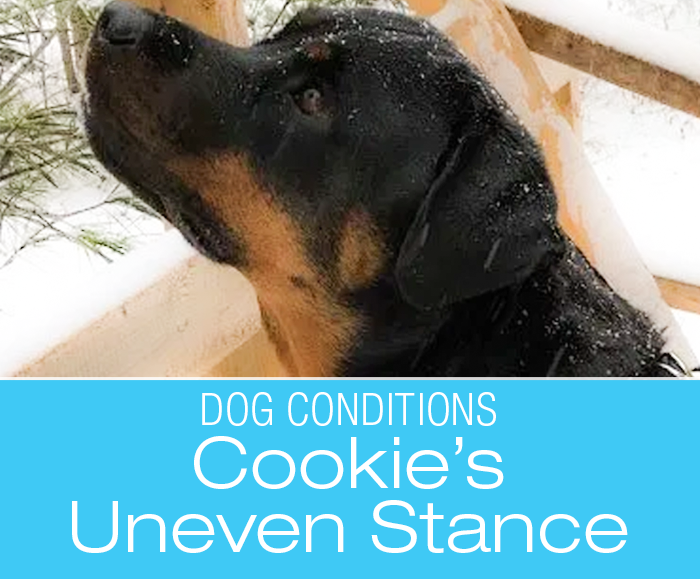
Uneven Stance in a Dog: You Don’t Always Have to See a Limp—Cookie’s Physio Update
Since the beginning, Cookie has had her share of musculoskeletal issues, even though the first major lameness had nothing to do with any of those things.
We thought she had busted her knee ligament; that’s how bad she looked. As it turned out, all that was caused by nothing more than a fragment of a porcupine quill in her foot.
That’s why it is important not to jump to any conclusion when your dog is limping.
I also do frequently point out that your dog might be favoring a leg without anybody actually being able to see a limp at all. That is why things such as paying attention to appearance are essential. If your dog’s hind end starts looking skinnier and shoulders broader, it is likely your dog has a problem with the hips. Whether there is a visible limp or not, there is an apparent shift of weight-bearing as the front compensates for the painful hindquarters.
It is the same with changes in muscle mass when one leg is getting less muscled than the other. Measuring circumference is a great tool to detect any subtle changes early.
It is about paying attention.
Often, also, the environment and the type of terrain can make detecting changes in gait impossible. How could one tell whether a dog is limping when they are stumbling through deep, crusty snow?
Which are the conditions we’ve had for quite some time now. The terrain is horrible, but Cookie still needs some fun and exercise. But even if she were favoring a leg, there would be no way for me to see that.
Did you know, though, that even something such as your dog’s posture when standing can tell you things?
Firstly, the simple willingness or unwillingness of staying in a standing position can be telling in itself. Just as you would seek a place to sit down if standing was painful.
The first time I saw Cookie standing unevenly, I figured it was because of the way she was turned.
I noticed that the left side of her rump was higher than the right side. The first time I saw that I figured it was just a coincidence. I even forgot all about it.
But then I noticed it again. And again. When she was “standing straight” she wasn’t standing straight. Fortunately, she was scheduled for a regular appointment with her PT.
Before each appointment, we always discuss any of my findings or observations. I did mention the state of the ground out there, due to which I did expect some muscle soreness. And I did mention my observations about Cookie’s stance.
After Cookie’s underwater treadmill session, assessment and massage, we learned what is going on.
Some of her back muscles were sore, which did not surprise me. The snow is deep with an ice layer half-way through it. Sometimes it carries her weight and sometimes not. When it doesn’t, her legs bust through it quite deep, and it must be quite a job for her to get herself out of it. I do try to go first and “punch” a trail for her, but she does not always follow. And that’s not counting her “wiping out” on some ice which was craftily hidden under a foot of snow which sat on top but didn’t adhere.
When walking on the treadmill, it was also discovered that she wasn’t fully completing the stride with her hind right leg. All the findings put together point to a sore sacroiliac joint. It’s not the first time these joints gave Cookie a hard time. She does have some abnormalities due to an old pelvic injury.
The important thing is, though, that we caught it early and can now work to address it before it could become a major problem.
Next week, Cookie is going to get another chiropractic adjustment, we’ll do her physio and laser therapy more often for the time being and monitor how the joint does.
Paying attention is important.
Related articles:
Our First Health-Related Heart Attack With Cookie: The Knee Or The Foot?
Further reading:
Abnormalities of Posture and Appearance