Fatty Tumors in Dogs: If It’s Got To Be A Lump, Let It Be Lipoma
A lipoma is a soft, round, moveable lump of fatty tissue under the skin.
Lipomas are common benign tumors in dogs. Awesome—we can all go home now, right?
Wrong.
Never assume your dog’s lump is just a fatty tumor. Never let your veterinarian diagnose a lump by feel alone. The only way to identify a tumor is a fine needle aspirate—even a veterinary oncologist can’t tell what it is without looking at the cells.
The other day I met a nice family walking their mix-breed dog, a friendly fella. As I was petting him, I felt a fairly large lump under his neck.
I asked if they knew about it.
“Yes,” they said, “we’re quite sure it’s a lipoma.”
The first rule of lumps—don’t be quite sure. Be SURE.

Growths that Can Mimic Lipomas
Many different lumps can look and feel like a lipoma. Things that can be mistaken for lipomas include:
- cysts
- abscesses
- mast cell tumors
- soft tissue sarcomas
- liposarcoma (malignant fatty tumor)
- other skin or connective tissue tumors
Multiple Skin Masses: Bobby’s Story

Bobby was a cheerful Welsh Terrier. While he was recovering from intestinal cancer treatment, his dad noticed nine small skin bumps. They looked harmless—pink, raised, and cauliflower-like. Easy to shrug off.
Over time, a couple of them started to change in shape and color. As soon as Bobby could handle further treatment, his dad removed them and sent the whole lot to the lab.
Those nine innocent-looking bumps turned out to be six different types of masses—some benign, some cancerous. Two were melanomas that could have easily slipped under the radar.
No matter how similar lumps look, they aren’t always the same. Every lump deserves individual attention.

What Is a Lipoma Anyway?
If you do find a lump on your dog, lipoma is a word you want to hear. Lipomas are common, benign tumors made up from mature fat cells and connective tissue. They are painless and mostly don’t cause any trouble.
They tend to show up most often in middle-aged and senior dogs, especially those who are overweight. As dogs age—especially if they carry extra weight—fat cells can clump together and form bundled deposits under the skin.
With weight gain, fat cells first get bigger. With long-term obesity, the cells reach their capacity and the body starts making new ones. More cells mean more chances for a little cluster to start growing on its own.
Normal body fat forms a smooth layer. A lipoma is a slow-growing, localized, benign neoplasm of fat cells.
Most lipomas grow slowly over months or years. Many stay small and never need treatment. They only become a concern if they grow large, interfere with movement, or start changing quickly.
Signs and symptoms
- soft, squishy, doughy lump under the skin
- moves easily when you push it
- painless to touch
- slow growth over months or years
- skin looks normal over it
- often found on chest, belly, or legs
Bruin’s Lipoma
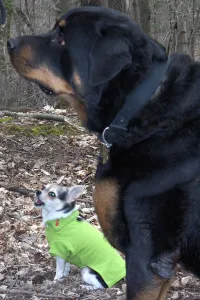
From the day our late rescue, Bruin, came to us, I was convinced that his chest looked weird.
It was most obvious when he sat. Nobody else saw it—not even the vet.
“He’s just a big boy,” they said.
And he was. He was overweight and built like a beer barrel. As he joined routine and regular walks, he started slimming down.
And then it happened.
While the dogs were having a good time at friend’s horse farm, I got a distraught call from my husband—Bruin has a huge lump on his chest! He rushed Bruin to the vet. Biopsy confirmed the giant growth was a lipoma.
The lump was the size of a baseball!
Where would it suddenly come from? Nobody grows a lump that size overnight. It was there, quietly growing on his chest for years. But as Bruin was losing weight, it must have gotten lose and shifted to the side. It definitely became apparent then!
Because of Bruin’s age, we decided to leave it alone. It was giant but not really in the way. Over time, though, it shifted toward his armpit and started interfering with movement. By then, surgery felt even riskier.
Bruin lived out the rest of his life a bit clumsily but happily. Still, if the lipoma had been discovered sooner, it could have been removed before it began affecting his movement.
It’s one reason to think about removing lipomas early, especially in areas that could affect mobility.
Do Lipomas Regrow?
When a lipoma is completely removed, it typically doesn’t grow back.
Dogs who develop one lipoma often develop others over time. These are new growths, not the old one returning. In other words, lipomas are not likely to regrow—some dogs are simply prone to making more.
Occasionally, a lipoma can come back if some tissue was left behind during surgery. In rare cases, deeper or infiltrative lipomas are harder to remove completely and may recur.
If you notice a lump reappearing in the same place, have it checked again.
Infiltrative Lipomas
In rare cases, a lipoma can grow into nearby muscle or connective tissue instead of sitting neatly under the skin.
While still benign, they are locally invasive. Infiltrative limpomas tend to feel deeper, firmer, and less movable. Because they weave into surrounding tissue, they can interfere with movement or cause pain. They are also harder to remove completely.
Signs and symptoms
- feels deeper, firmer, or stuck in place
- less movable than a typical lipoma
- may grow into muscle or along tissue planes
- can cause stiffness, limping, or reduced range of motion
- may be uncomfortable or painful
- harder to remove completely
Further reading: Infiltrative lipoma in dogs
Myelolipoma
Myelolipomas are rare. They are made of both fat and bone-marrow-like tissue.
Unlike lipomas, which sit under the skin, myelolipomas usually form deeper inside the body and are often discovered during imaging or surgery rather than by feel. They’re most commonly found on the adrenal glands, liver, or spleen.
Many stay small and quiet for years. But location matters. When they grow large—especially on the spleen—they can cause real problems, including discomfort or internal bleeding.
That’s what happened with Cookie—imaging revealed a splenic mass, and I insisted on surgery right away. With splenic tumors, removal is both treatment and diagnosis. The surgery gave her another good year of quality life.
Signs and symptoms
- often no symptoms
- usually found incidentally on imaging or surgery
- when large, may cause abdominal discomfort or fullness
- organ-specific signs (loss of appetite, lethargy, vomiting, diarrhea, weakness)
- splenic masses may bleed → sudden weakness, pale gums, collapse (emergency)
Liposarcoma
A liposarcoma is a malignant tumor of fat tissue. Although it rarely spreads to distant organs, it tends to grow into surrounding tissue and usually requires more aggressive treatment.
Even if your dog has already been diagnosed with a benign lipoma, any lump that changes shape, feels firmer, or starts growing quickly should be rechecked to rule out cancer.
Signs and symptoms
- firm or irregular lump
- fixed to underlying tissue
- faster growth
- may feel uneven rather than smooth
- can cause pain or inflammation
- may recur after removal
- possible weight loss or low energy in advanced cases
Breed Specific Notes
Some breeds seem more prone to developing multiple lipomas, especially as they age or gain weight:
- Labrador Retrievers
- Golden Retrievers
- Doberman Pinschers
- Miniature Schnauzers
- Cocker Spaniels
- Weimaraners
Middle-aged and senior dogs—particularly overweight dogs—are affected most often.
When to See a Vet

Have any new lump checked if:
- it’s about the size of a pea and still there after a month
- it grows quickly
- it feels firm, fixed, or irregular instead of soft and movable
- it changes shape or texture
- it becomes painful
- it interferes with movement
- your dog seems lethargic, uncomfortable, or “not themselves”
A simple fine needle aspirate can usually tell you what you’re dealing with—and peace of mind is worth it.
Fatty Tumors in Dogs in Closing
Most lipomas are harmless, but no test is perfect. A needle aspirate samples only a small portion of a lump. If the sample collects only normal fat cells, a more serious tumor hiding deeper inside can occasionally be missed.
And over time, new growths can also develop in the same area. So a lump that changes size, becomes firm or fixed, or starts growing quickly deserves another look—even if it was previously called a lipoma.
Track it. A quick measurement or photo each month makes it much easier to spot subtle changes.
Fatty Tumors in Dogs FAQ
No. Many lumps feel soft and movable. The only way to know what it is for sure is to look at the cells with a needle aspirate or biopsy.
Most don’t. They’re usually painless and only become a problem if they grow large or sit where they rub or interfere with movement.
Yes. Even experienced vets can’t reliably identify a lump by feel alone. A quick aspirate is simple and provides peace of mind.
Typical lipomas don’t “turn into” cancer. But other tumors can look similar, and rarely something more serious may be hiding or develop later. If a lump changes, have it rechecked.
Usually no. If completely removed, it doesn’t regrow. Dogs that get lipomas often develop new ones over time, but those are separate growths.
Not necessarily. Many can simply be monitored. Removal makes sense if they grow quickly, cause discomfort, or are located where they may interfere with mobility.
Related articles:
Primer On Lipomas
Don’t Wait to Aspirate: JD Grows New Bumps
Further reading:
Adipose (Lipoma) Tumors
Oh, boy, I’ve had more than my fair share of lipomas with my five Huskies…whew. I so agree that they need to be checked and aspirated. Thankfully my FiveSibes’ were all benign, some having been surgically removed. One was so bizarre I wrote about it. It presented itself on the surface like a cauliflower growth, but once he was under, the growth on the elbow was bizarre, it looked like a little foot! My vet was shocked…and it’s even mentioned in his new book. How something like that…and hidden under on the elbow no less, was mind-boggling. Wolfie did well after the surgery, but I was so thankful I always had them checked out. Excellent article, Jana. Sharing with my readers.
Wow, cauliflower-like lipoma? So strange–normally those would be papilomas. But having a little alien foot growing under the surface? As long as it was benign, though.
Every time I brush Nili or pet her I check for lumps and bumps as it is my biggest fear, great post and information
Yes, perfect. That’s the added advantage of thoughtful grooming–finding things as they crop up.
Don’t be overly afraid, though. Majority of lumps or bumps found on or under a dog’s skin are benign. Only between 20-40% are cancerous.
Some studies suggest up to 60-80% of skin tumors are benign. That doesn’t mean they don’t need to get aspirated.
Further, the younger the dog, the lower the odds of a bad growth.
Super info! My Henry has a lump that after a biopsy was pronounced as just a fatty tumor. The vet said to expect more. He’s got cocker in him so that must be why he’s more prone to them.
Fatty tumor is the diagnosis you want to hear.