
Veterinary Thermal Imaging: Veterinary Highlights
Infrared thermography detects heat patterns in the infrared wave-length spectrum that are not visible to the eye.
I have been excited about the veterinary thermal imaging stuff for a long time. It’s non-invasive, and I feel it can offer unique insights. I’ve been trying to get any of our vets or physical therapists to get one of these.

I talked to Veterinary Thermal Imaging and they provided me with some recent case studies.
So far, this technology mostly made its way mainly into diagnostics of zoo animals and horses. I’d love to see it being used more on dogs also. But some places pioneer its use.
Intermittent lameness in a Cocker Spaniel
An uninsured 9-year-old Cocker Spaniel, with intermittent lameness.
The owner felt that that problem was in the left hind leg. General x-rays of the limb were inconclusive, MRI scanning was cost-prohibitive. Referred for Thermal Imaging by a Swindon Veterinary Hospital, which highlighted the problem to actually be in the right hind, within the aponeurosis of the adducts.
 |
| Left hind |
 |
| Right hind |
Ordinarily, the animal should be thermally symmetrical, deviation from this indicates an underlying problem.
With the problematic area pinpointed, and using the dynamic image function of the camera during the clinical examination to direct the vet to the seat of the inflammation, this could then be felt on careful palpation.
The condition resolved with Metacam, physio, and remedial exercise program, no further diagnostic tests or expense on the owners’ part required.
Epulis (tumor of the gums) in a Labrador Retriever
Uninsured 9-year-old Labrador bitch, referred by Oxfordshire based veterinary hospital. Presented with an ulcerating epulis in left commissure of mouth. MRI costs were prohibitive.
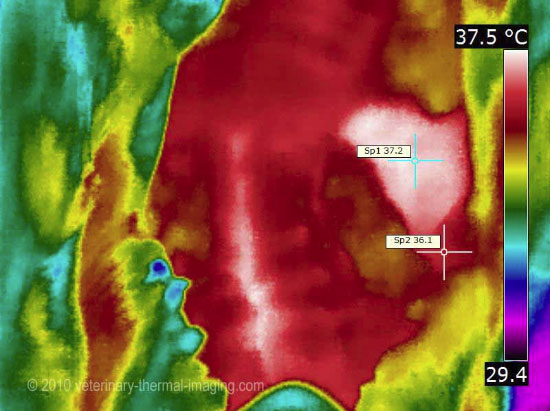
Thermal Imaging showed the extent of the mass prior to de-bulking (in conjunction with lateral and ventral views), and the spot temperature readings confirmed that there was a significantly increased temperature reading in the area consistent with the increased vasculature seen in malignant growth.
The owner, previously unconvinced of the need to biopsy was persuaded to do so by the thermal images.
Advantages of thermal imaging
Thermography is an affordable, non-invasive diagnostic tool. Thermal imaging does not use radiation which makes it perfectly safe. It can be used to detect many injuries and health conditions.
Of course, it’s not as easy as it sounds. The practitioner needs to know what they’re doing and the camera presently available in Canada for this use is awkward with a cumbersome interface.
The technique itself, has tremendous future in my opinion.
Related articles:
Veterinary Infrared Thermography: Thermal Imaging Diagnoses Early IVDD: Jack’s Story
Further reading:
Veterinary Uses for Thermal Camera