
Sudden Withdrawn Behavior in a Dog: Igloo’s Change in Behavior and Hiding
What would you make of it if your dog suddenly withdrew from interaction and started hiding?
Would you chalk it up to stress? Depending on the circumstances and your dog’s history, you could be right. Fear and anxiety can be behind your dog hiding, especially if they have history of noise phobias or something potentially stressful happened in their life.
However, be aware that pain or illness can have the same effect. If you find your dog slinking under the bed, the back of the closet, or any hiding place they might find, consider the big picture. You might detect other signs such as changes in gait or posture, lethargy, loss of appetite, and other changes. Such a dog needs to see a veterinarian.
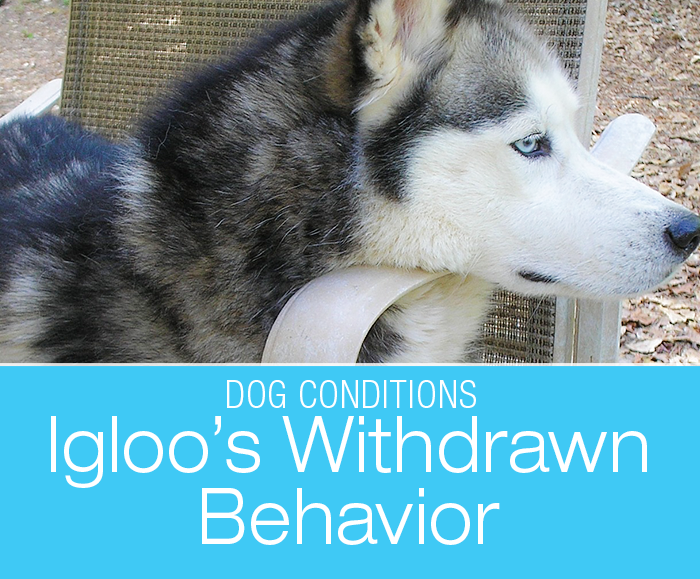
Igloo’s story
Igloo was a 7-year-old Siberian Husky. True to her breed, she was an active dog who enjoyed long walks and rough play with his housemate. Their play involved high speeds and dramatic maneuvers, and they loved it.
That day, Igloo abruptly stopped playing and no longer wanted to engage. Instead, she sought refuge in nearby bushes. Immediately, Igloo’s mom knew that something was amiss and made an appointment with their veterinarian.
At the veterinarian
Before the appointment, the veterinarian reviewed Igloo’s medical history. As it turned out, Igloo visited with a similar problem about a year prior. Similar, not the same. At that time, Igloo had trouble jumping into a vehicle, cried when getting up from rest, and yelped when her mom touched her lower back.
As it turned out, Igloo’s left lower back was painful. Did she get hurt? Did she have a disc problem? To start, the veterinarian prescribe anti-inflammatory medication and rest which did the trick. After couple of months, Igloo was back to her normal, active self.
The diagnosis
Was Igloo’s problem now the same as then? With high care, the veterinarian examined Igloo. After careful pushing and poking, the veterinarian found the sore area. This time, Igloo hurt on both sides of her lower back where the spine connects to the sacrum. This part of the spine is especially vulnerable to injuries and disc problems because of how weight shifts during jumps and twists.
To pinpoint the exact problem, Igloo would need an MRI scan. However, it makes sense to start off with pain relief and rest first. Frequently, that is all that’s needed.
Lumbosacral syndrome
Igloo’s condition is referred to as a lumbosacral syndrome. This painful problem can have several underlying causes, including:
- narrowed spinal canal due to arthritis
- herniated disc
- trauma
- congenital malformations
- tumor
Pain is the hallmark symptom of the lumbosacral syndrome. Other issues might include
- muscle atrophy and resulting weakness
- incontinence
- chewing of feed or tail
If the problem is disc related and the disc ruptures, the dog might loose coordination or become paralyzed in the hind legs.
Further information: Lumbosacral Syndrome in Dogs
Igloo’s prognosis
Most dogs recover with medical treatment and rest. However, such a problem is likely to recur. There is a relatively small risk that at some point Igloo will face a serious problem that doesn’t respond to medication and might require surgery. Hopefully, that does not happen.
In closing
Igloo’s story is an example of how essential it is to pay attention to any changes in your dog’s behavior. Something as seemingly unimportant as hiding is often sigh of serious pain.
Source story:
Igloo is a 7 year old Siberian Husky
Related articles:
Why Is My Dog Acting Strange: Changes In Canine Behavior and Habits
Further reading:
Why Do Pets Hide When They’re Sick?
I have a friend who’s poodle is having similar problems. I need to share this with her.
It is so important to pay attention to our dogs. I’m glad that Igloo got the medical attention he needed. Hopefully, he won’t have any more trouble.
Igloo is so beautiful! Having a Husky myself this really touches my heart. I’m so glad it wasn’t anything too traumatic for her and that rest + anti-inflammatories helped her.
Love & Biscuits,
Dogs Luv Us and We Luv Them
So glad that Igloo received the care he needed. When dogs behavior change, we really have to pay attention. Igloo’s story is a great testament to why this is so important.
Dogs are like cats, they pretend they are fine when they might not be. This can cause a lot of problems so you need to be alert on walks and during playtime. Small things can trigger larger problems so catching something early, like Igloo’s back issues means she can be treated and (I hope) maybe avoid surgery.
Thank you for sharing this – I think we often overlook how powerful our familiarity with our pets can be in terms of catching injuries or illnesses early. We know what’s ‘normal’ and notice when something seems ‘off’ or ‘different’ in the behaviour of our pets. I have never heard of Lumbosacral syndrome before, so this was really interesting to me. Some information to store away in the back of my mind in the event that I see any signs pointing to it in the future with my pups.
I never heard of Lumbosacral syndrome before. Yes, it’s always important to pay attention to your pet’s changes in behavior so you can see a vet and get the issue checked out sooner vs. later. Smaller problems are easier to resolve vs. bigger problems. I hope Igloo is doing much better and doesn’t encounter this issue again. (fingers crossed)
Great information. Thank you for sharing this. Dogs hide pain so well, but they usually find a way to show us something is wrong. Sudden change in behavior is definitely good indication that something is going on.