
Mast Cell Tumor Diagnosis: JD’s Biopsy Results Revealed Mast Cell Tumor—You Don’t Know What the Bump Is Unless You Look at the Cells
Nobody, not even a veterinary oncologist, can identify a bump just by looking at it.
There is no point in guessing and there is no point to watch potential cancer grow. Don’t wait. Aspirate.

JD’s story
We found three bumps on JD which we had checked out last week. One of them, looking like a skin tag, is a skin tag. We had the other two aspirated because no matter how much you stare at or play with a bump, you cannot tell what it is by doing that.
One of JD’s bumps was preliminarily thought to be a lipoma and the other one probably a cyst. JD is another example why you want to biopsy every bump you find, no matter how little and how innocent it might look.
Biopsy results
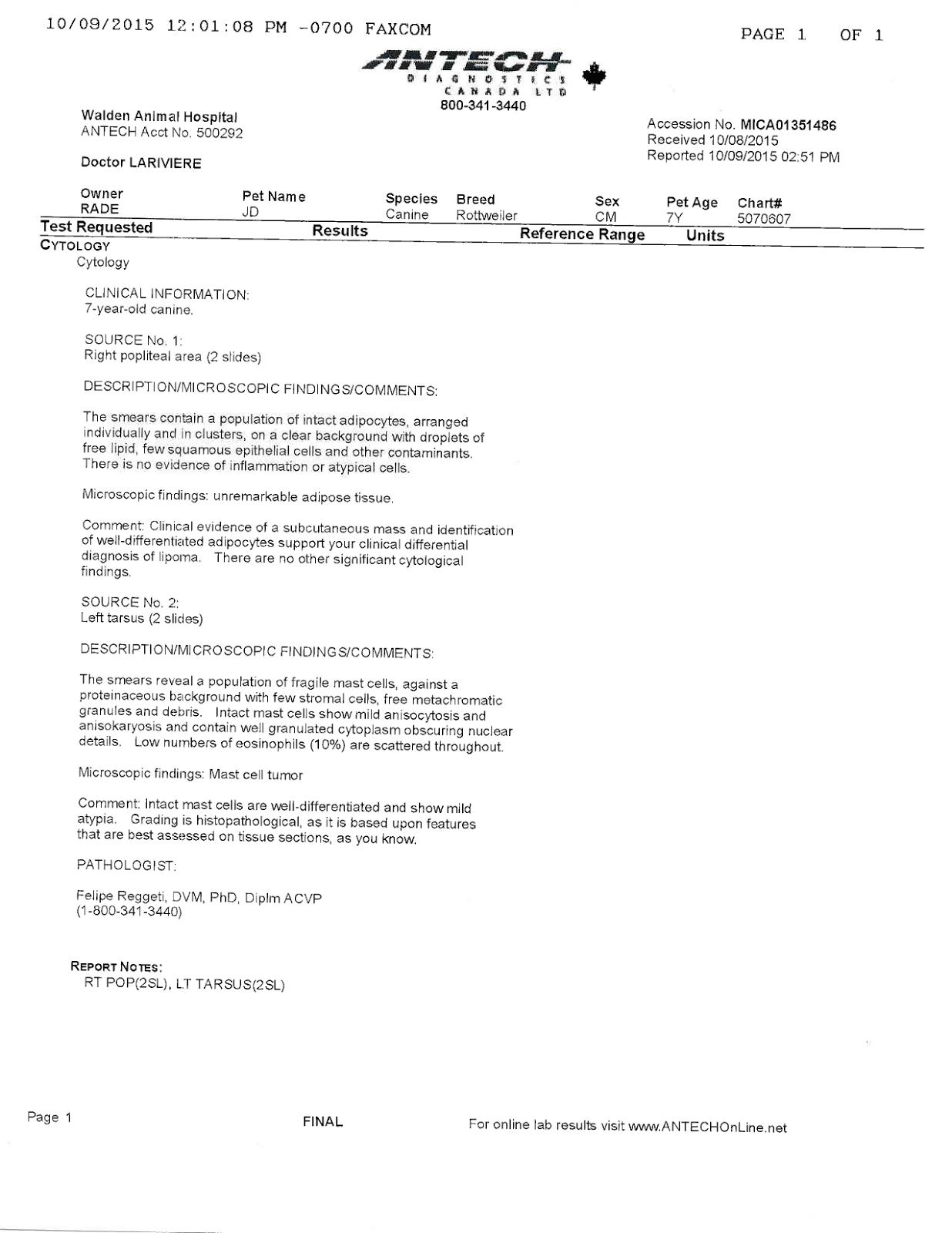
The biopsy results came back this morning.
The bump on his thigh is indeed a lipoma as thought. There were no suspicious findings on that one. The other one, however, is not a cyst after all.
The bump on JD’s tarsus is a mast cell tumor.
Tiny, innocent-looking little thing. Not at all the typical lesion, you’d expect to see. Yet not so innocent after all. Mast cell tumors can indeed look like anything or look like nothing much at all.
What is a mast cell tumor?
A mast cell tumor (MTC) is cancer of specialized, histamine-releasing immune cells found in connective tissue – mast cells. MTCs account for up to 20% of skin tumors in dogs. If we’re lucky, surgery can be all the treatment needed. The biopsy result says that the cells show mild atypia.
JD is perfectly happy and doesn’t know he should be worried about something.
Identified it early
The upside is that JD’s tumor is very tiny and now we know what is is.
JD is scheduled for surgery on Friday. Then another biopsy and staging of the tumor. Surgery is the treatment of choice for MCT, and often the only treatment needed.
I’m a bit concerned about the location because where it is there isn’t much surrounding tissue to remove at all. Will we be able to get clean margins? Ideally, two centimeters of tissue should ideally be removed all around. But there isn’t much of all around there. We may or may not have to follow the surgery with radiation therapy. For now, we’re going to get it out and see what else needs to be done.
Aspirate every bump
JD’s bump isn’t the only example of why it is important to aspirate each and every bump.
I was following what I believed was the best thing to do but at times I wondered whether I was being overzealous. But clearly, I was not.
Don’t wait, aspirate.
Related articles:
Canine Mast Cell Tumors: JD’s Mast Cell Tumor Diagnostics, Strategy, and Treatment
Mast Cell Tumor Treatment: JD’s Mast Cell Tumor— Surgery and Pathology Report
Further reading:
Your Dog Has a Mast Cell Tumor, Now What