
IMHA Complications in a Dog: Whitney’s Lost Battle
Immune-mediated hemolytic anemia (IMHA) is a condition in which the dog’s immune system attacks its own red blood cells.
If severe anemia wasn’t bad enough, IMHA is notorious for its complications. The most common complication is thromboembolic disease. As a result, blood can clot within vital organs and cause difficulty breathing and even sudden death.
Source: South Carolina Veterinary Specialists
Thank you, Jaimy Orr, for sharing Whitney’s story.
Whitney’s story
We lost our dog Whitney to IMHA complications just last night.
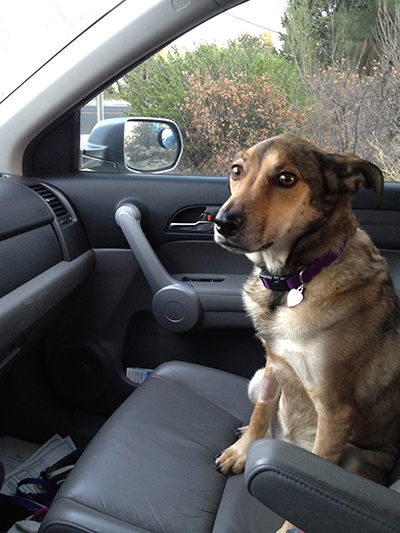
Whitney was a small German Shepherd mix rescue. She was diagnosed just 5 days after we had to put our 13-year-old boy, Ziggy, down due to cancer.
Whitney showed signs of tiredness and loss of appetite. At first, we thought it was depression from missing her housemate.
Whitney was put on prednisone, cyclosporine, and maybe a few others but continued to get worse slowly.
Whitney received her first blood transfusion by late February after a Packed Cell Volume (PCV) of 11. She was put on azithromycin. Then we found her lying on the floor, unable to move or even pick her own head up.
Emergency clinic visit
Whitney had been acting strange the day before, but it was a Sunday. So I chose to wait until Monday before getting her medical attention.
Instead, we rushed her to the emergency vet at 4:30 a.m. There we learned she had liver septicemia from all the meds with a fever of 105.
They gave her IV fluids and antibiotics and took her off the azithromycin. Instead, she received mycophenolate (an immunosuppressant more forgiving for the liver).
We never had any further problems with her liver after that, and she recovered well.
Improvement and decline
Over the next months, her PCV increased to as high as 30. However, it eventually started to decline as low as the low 20’s.
Her cyclosporine was increased after that, and slowly her PCV started to increase. But she started getting a lot of infections due to how immuno-suppressed she was.
She had severe—skin infections. However, the worst was two severe bladder infections just over the last few weeks of her life.
After the first bladder infection was treated, she was doing better than ever.
The vet started to taper off her prednisone in an attempt to get rid of some of the immuno-suppression. Next, we would taper the cyclosporine.
That night, Whitney laid next to me on the couch as she always did—but she was shivering.
Back at the veterinarian
We rushed her back to the vet. We figured her bladder infection came back or never fully went away.
Over the next 24 hrs, she was lethargic, and her appetite was worsening, although her fever was going down.
She was taken to emergency care, where she received IV fluids, antibiotics, and pain meds due to her whimpering and crying out.
All of her bloodwork was normal (liver, kidney, and PCV had even increased).
Unresolved complications
The Dr.’s were perplexed and suspected meningitis, septicemia, and possibly an infection in her brain.
They treated Whitney with high doses of IV antibiotics and said she would either overcome this infection or this would be the end of her fight.
My husband and I went to work this day because she was at the hospital in the care of her very favorite vet (they had become very close after so many visits, and Whitney particularly enjoyed the Starbuck’s breakfast sandwiches the Dr. would get and share with her anytime she saw her on the schedule:)) so we knew she was in familiar and capable hands.
I gave the vet permission to let her go if she took a turn for the worse.
Our main goal was not to let her suffer.
When I left work that evening, I saw a text from the vet. Whitney had gotten worse, and my husband was on his way over.
I knew in my heart that this was the end. ‘Worse” didn’t seem possible from the condition I had left her in that morning.
My husband did not even make it there in time. After only 10 minutes of driving, the vet called back to say she had had to let her go.
A blood clot?
The vet suspected a clot or a bleed to Whitney’s brain.
It breaks my heart that she had to suffer that much. But, I know she had to be for the vet to let her go without waiting for our arrival. The vet spared us the details. But she said that after a long of resting on morphine, Whitney awoke in agonizing pain.
When I arrived at the vet’s office, my husband sat on a couch crying with her in his arms.
Whitney was only 2 years old. I have a hard time without my little shadow to follow me around.
Takeaway points
These are two major points I would like your readers to take from Whitney’s story.
- Work with a vet who is capable. Our vet was in a clinic that was very advanced and she worked alongside a specialist’s advice the entire time.
- Also, have a thermometer and use it anytime your dog is acting off. Only you know normal behavior for your dog. Many times I would take Whitney in without having an actual reason, she just wasn’t herself. Not one of those times was I wrong/ Each visit it had turned out something was in fact going on.
None of it would bring her back. But my ultimate goal was to have her comfortable and keep her with us as long as possible.
Get educated as possible about the disease once it is diagnosed and don’t stop at the education of your veterinarian.
Get online and read, read articles and blogs, and get familiar with the meds and scenarios. Otherwise, it can be overwhelming when you are caught in a crisis because you will be clueless. This really helped us cope. I hope Whitney is in heaven with our beloved Ziggy playing and talking about how much we loved them.
Related articles:
IMHA in Dogs: Dr. Jekyll And Mr. Hyde—Razzle’s Immune Mediated Hemolytic Anemia
Immune-Mediated Hemolytic Anemia: Annie’s Lost Battle with IMHA
Further reading:
The Reality of a Dog With IMHA