
Canine Allergy Blood Testing: Jasmine’s Allergy Blood Test Results—We Ruled Out Everything Else
For the longest time, Jasmine’s vet and us couldn’t agree whether allergies could be behind Jasmine’s episodes (and some of her other off-and-on issues)
Allergies have always been one of the theories on the table, with our vet being quite convinced that this is at the root of the problem.
Allergies might be the most viable theory we have, at least one that couldn’t be disproven—does that make it a good one, though?

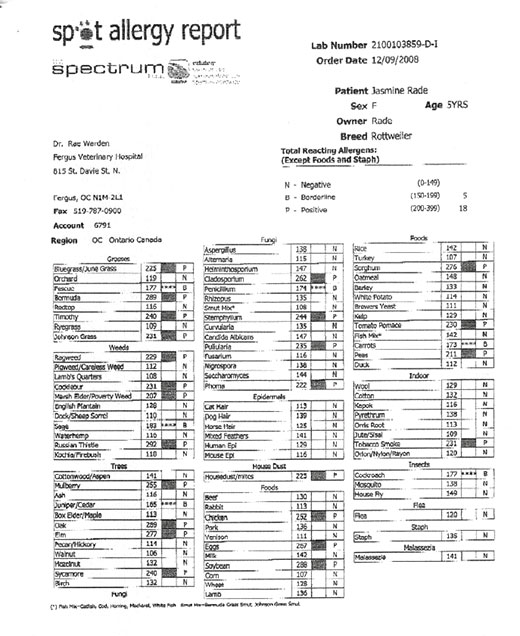
Spot allergy report
It is true that Jasmine’s past allergy test came back positive for all kinds of things. As well it is true that long enough into an episode she will start licking and chewing at her front feet (the episode has to last at least 5 hours for that to happen). It is also true that the release of histamine could lead to a rise in temperature and panting.
Jasmine is not an itchy dog
On the other hand, Jasmine is not an itchy dog! She is the least itchy member of the household! Her episodes seem related to weather changes but NOT seasons. Her appetite and stool quality doesn’t seem to have any correlation to the episodes.
If this is a disagreement we’ve had for a long time, why does it matter now?
Because now the sublingual immunotherapy (SLIT) is available. It seems to have good results and it is way safer than the injections. So IF allergies were indeed behind Jasmine’s episodes, this would be a good way to go.
So what’s the problem?
Well, for one thing, I do agree with the philosophy “if it ain’t broke, don’t fix it.” Do positive lab results really always translate into actual problems? In the past, hubby had tested positive for about everything under the sun, and only a couple of specific pollens actually give him real trouble.
Of course, there is no harm in testing, other than this test requires quite a large amount of blood, which will make Jasmine pretty unhappy, and one has to wonder how much being under stress may or may not affect the results.
Secondly, the lab that provides the SLIT for us up here in Canada has quite a stiff price for the testing bit.
- allergy testing indoor, outdoor and common foods $398
- optional, but recommended, allergy testing for uncommon foods $102
- if a candidate for allergy drops, 12 allergens or less $135
- 22 allergens or less $195.
This whole adventure could add up to $695.
If we were to do this, it would make sense to go with the whole shebang. Not that we haven’t spent (and spend regularly) a whole lot more on Jasmine, but we don’t have an extra seven hundred dollars lying around. And if we do come up with it, what if something else crops up? (not unusual for Jasmine at all)
Here is the thing. If I were convinced that the allergies are the problem, we’d do it, no doubt.
Not convinced
But neither hubby or I are convinced.
We love our vet. I know he has a picture in his mind, based on the available information and his experience. Unfortunately, this picture doesn’t match to the one in our minds. On the other hand, he is an awesome vet and we put a huge value on his expertise; he’s earned it. Otherwise, we wouldn’t be having a dilemma in the first place. But we see Jasmine 24/7.
Avoiding making the wrong call
My biggest concern is and has always been, making a wrong call for Jasmine.
What if it really is allergies and the treatment could just be the miracle she needs?
What if it is not, or the treatment doesn’t work (doesn’t work in about 30% of dogs) and we spend all this money and won’t have it to deal with something else urgent that comes up? Jasmine’s maintenance doesn’t come cheap. There is her chiropractic care, hydrotherapy, and acupuncture she gets regularly. She does seem to be benefiting from those. Then there are all the supplements and goodies she gets. And then there is the precedence of something always cropping up.
A second opinion
For a fresh set of eyes, yet again, I turned to VetLive.
VetLive has become my go-to place when facing a dilemma or dealing with a problem when our vet isn’t available.
They tend to agree that this doesn’t look like allergies. You would think that would make me feel better and make my decision easier.
Interestingly enough, this did NOT make me feel better or make my decision easier.
Perhaps I was hoping they’d agree that it IS allergies? Is it possible that our observations are more truthful than our vet’s conclusions? He is, after all, THE vet—REALLY smart, competent, experienced and invested in Jasmine’s well-being.
Another thing is that we cannot take forever with our decision.
The treatment takes quite a long time, it is best done during allergy off-season, and I’d prefer to do this outside any vaccinations or other challenges to the immune system. Jasmine will be due for lepto as well as her 3-year rabies vaccine next spring. I would also like to keep these to apart and fit them into the allergy off-season. Which means we’d best start as soon as possible.
Presently we’re having an ongoing dialog with Jasmine’s vet. Somehow we need to come to an agreement. We have to come to a conclusion we can both be convinced is right.
What do you think? What is your experience with allergies in your dog?
VetLive consultation
Here is the conversation we had with VetLive.
VetLive: Is there anything in Jasmine’s history, other than the feet and occasional eye discharge that is making your vet think this [immunotherapy] is a good route (not saying it’s not, I just want to make sure I have as complete a picture as possible).
As far as the panic and distress, what happens? Any idea what causes this? Is this a new problem?
Has the foot chewing gotten worse over time? Is it seasonal? Is it only after panic, stress, boredom, anxiety?
What treatment do you do for the pododermatitis?
Also, there is obviously no harm in doing the testing; do you want another opinion as if I think it is a good way to spend limited funds? I have done some initial research on SLIT and so far, it looks pretty promising. I have no experience with it myself so I would like to see if I can learn what a dermatologist or clinician with a strong interest in allergies has to say about it.
Jana: She does have eosinophilic gastroenteritis which was concluded to be a result of food allergies (SLIT environmental ones only, though)
It is true that the old test does list a number of allergies to all kinds of things.
It is also true, though, that she gets the episodes independent on seasons.
Her vet observed her during one of the episodes when she was seriously going after her front feet.
It is true that she tends to eventually have raised temperature if the episode lasts long enough, which could possibly be as a result of histamine release?)
These episodes can last anywhere from 30 minutes to 36 hours. There seem to be a correlation between the episodes and weather changes (typically BEFORE, not DURING storm etc; weather change without a storm, such as now Sandy, will likely lead to one also)
All other theories about what is causing the episodes on and off the table (e.g. not Cushing’s; I don’t believe actual panic/anxiety …). Atypical Cushing’s considered but was told that the effects of treatment likely make her more miserable than the problem itself if that was the case.
The episodes are not a new problem, started when she was about 2. Interestingly, when diagnosed with hypothyroidism and put on Thyrotabs, episodes disappeared for about half a year; just to return again (and this seems not related to her thyroid hormone levels)
Foot chewing only long into an episode. Some time back she was licking her foot a lot (that’s when the swelling, fungal infection and furuncle discovered).
My observation is that
a) licking follows infection, not the other way around; of course I could be wrong
b) front feet start bothering her when episode lasts long enough
Feet were treated with either Dermacool, kept under control by spraying ear cleaner from all things, or 50/50 betadine/rubbing alcohol
There is no harm in the testing part (other than a large volume of blood which she will hate having taken) other than the cost ($500) which is money we won’t have available for other things. So the question is whether this is a beneficial investment or taking resources from things she might need/benefit from more
There is slight potential harm from the treatment, for which this testing would be done, hopefully, Jasmine might surprise us and have no reaction.
So the reason for asking mainly is – should we drain resources by doing this or should we keep for other things (e.g. she is getting regular chiro, hydrotherapy, acupuncture, supplements – all these things cost money, plus something new might crop up)
Strangely enough, we still don’t grow money in trees … 😉
We find it difficult to invest $600 into something we are not convinced she needs. So the question is, does she need it and will she benefit from it?
I do think SLIT is a good thing to try IF dealing with allergies. (I do think that what they charge for the testing is rather criminal)
Reasons vet feels this better than injections
– lesser chance of adverse reaction (apparently no anaphylaxis reported with SLIT and only reports of minor local reactions such as mouth itching …? Of course Jasmine’s body has always its own ideas)
– apparently better outcome possibility with multiple allergens while traditional needle injection limited in results for multiple allergens?
– Jasmine hates needles
VetLive: When you did the testing in 2008, was any desensitization treatment pursued? If not, was there a reason?
As far as the testing, did you get a quote for intradermal testing? I know the Heska testing is expensive and the hospital I worked out that did intradermal was many years ago so I am not sure what the current costs associated with intradermal are but is considered superior.
Jana: No, on the premise that positive results unlikely with so many allergens and how does one pick just a couple? Also, that one was MAINLY done in the process of coming up with the IBD management. Also too many other things on the table then.
Didn’t consider intradermal, have to admit that I hate the idea of doing this to Jasmine, plus she has a hard time regrowing shaved fur.
You see, when I compare Jasmine with JD, for example, would have to be JD who suffers from allergies (scratching and licking himself way more than Jasmine). It is true he hasn’t had any skin infections or any other secondary issues but he is 10x itchier than Jasmine is.
VetLive: There are a couple of things that would make me “guess” more towards the side of no. It is such a tough call though because we know Jasmine isn’t normal and doesn’t tend to follow the typical information available.
Still, I am trying to be scientific and rational in my thinking. With just the foot chewing there, and it being year round, and associated at odd times, I am not convinced it is actual allergic chewing.
I think the hypothyroidism is more likely—statistically speaking—to be the cause of the skin problems, which don’t seem to be widespread skin problems. I also can’t make sense of the episodes and foot chewing stopping when the hypothyroidism was first diagnosed and treated. Yes, allergies get worse with time, but why did they stop if mysteriously at that time? True, it could have been a coincidence, but I think other reasons are more likely.
I understand too many things were on the table then, and I completely understand your and your vet’s reasoning. I wonder though, if she tests positive–mildly or strongly, whatever situation you want to imagine–how much is the SLIT going to cut into her other medical budget? Would you still pursue full-on treatment if her conditions don’t seem to be that severe (at least to me via an Internet consult). If it is going to cut money from chiro, hydro, etc. that you know helps her and she needs, I have a hard time putting foot itching above joint pain. I am not trying to belittle her foot itching, but with it being difficult to even classify it as true allergic itching, this is what brings me back to her needing the more concrete therapies that are keeping a dog with a plethora of ailments leading a happy and pretty healthy life, all considered.
It looks like SLIT is effective from the studies about 70-75% of the time. Some vets have raised questions about if this rate will be different for patients that have GI issues, like IBD. We don’t have much data available on this. This isn’t a reason to not try it of course and I know you aren’t one to hold off because something is new. But, it is because we are picking and choosing with limited funds that to ME, it becomes a consideration that I don’t believe I would pursue, at least at this time.
If her symptoms increased, changed, became seasonal, relentless, etc. then I think I would want to test. If she was itchy and as uncomfortable as JD even, then test. But I don’t know that I would prioritize this as one of her biggest issues (budget-wise).
The episodes don’t look like any allergies I’ve ever seen, heard of, or read about.
Jasmine’s test results brought more questions than answers.
Granted, the reason the lab (and the only place that will provide the SLIT treatment for Canada) insisted on getting a new test was that these things change over time. Ok, I can see that. It was actually my own thinking, that we should run a new test before treating.
Deciding to try the SLIT
After a month of deliberation, we’re going through with the sublingual immunotherapy (SLIT). I should have known better and just have agreed to it to start out with; could have saved myself the inner turmoil.
No, I am still not convinced that allergies are the cause behind Jasmine’s episodes. I really don’t think so. I am sure—but am I right? That is the question.
If I don’t think that allergies are really Jasmine’s problem, why did I decide to agree to the testing and potentially the treatment? (We have to do the test first to find out whether Jasmine is a good candidate for the SLIT treatment or not)
Because I could be wrong. There would always be the question: What if?
What if it really WAS allergies and the treatment could help Jasmine?
We love her vet for a reason. He is extremely smart, competent, and he really cares about Jasmine. He would also be the first one to tell us not to waste our money on something he felt wouldn’t have a real benefit, or the money would be best spent elsewhere.
Is he right about the allergies?
I don’t know. He believes so. I guess there is only one way to (potentially) find out. Potentially, because about 30% of dogs do not respond to immunotherapy, be it SLIT or injections. So there isn’t much assurance that all this will lead anywhere.
Bottom line is, I couldn’t bear passing on something that could help Jasmine.
The fact that we’re not at all that convinced that allergies are to blame for Jasmine’s episodes aside, other criteria which should be considered to check out.
1) Is the testing invasive or risky?
No, it’s just a blood test and even though Jasmine hates getting her blood taking, there is no risk to her to speak of.
2) Is the treatment invasive or risky?
There is some risk with any treatment, but the allergy drops have reported as quite safe, and substantially safer than the injections.
3) Will the treatment improve Jasmine’s quality of life?
Well, that is the question, isn’t it? If allergies are causing her trouble after all, then it might.
The main reason we were struggling with this decision was
4) Will go through with the testing and treatment use up funds that might be more needed elsewhere?
To address this we decided to test for indoor/outdoor environmental allergies only at this time. That would bring the testing bit down to $300 plus whatever the cost of the proposed treatment ($135 or $195). It would be nice to revisit the food allergens as well, but since it is not pertinent to the SLIT treatment, it can wait.
So we’re booking an appointment to get the blood drawn and then we’ll have to wait and see whether Jasmine is a good candidate or not.
Reviewing already ruled out possibilities
During our back and forth discussions with Jasmine’s vet (God bless his patience) we revisited some of the other possible causes, and one of them kind of made it back on the table.
Could it be that Jasmine’s episodes are caused by some kind of heart arrhythmia?
We know that there is nothing structurally wrong with her heart, but could it be an electrical problem? Something like that could certainly cause
- stress
- poor circulation in extremities (a possible explanation for the paw chewing)
- could last a few hours or a couple of days
- could start at an early age
Not that I like that possibility better…
But it made its way back on the table and we are figuring out how to best confirm or exclude that one. Frankly, it would fit with my observations better than the allergies. But I’d still prefer if it was not it.
Old and new testing comparison
How much, though, can things change?
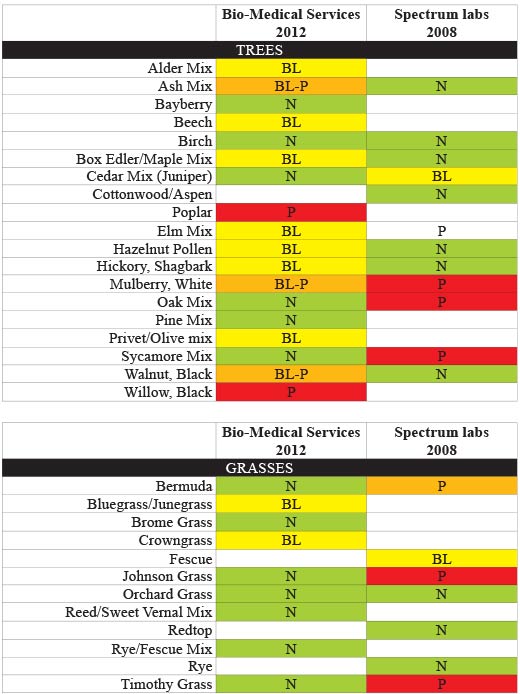
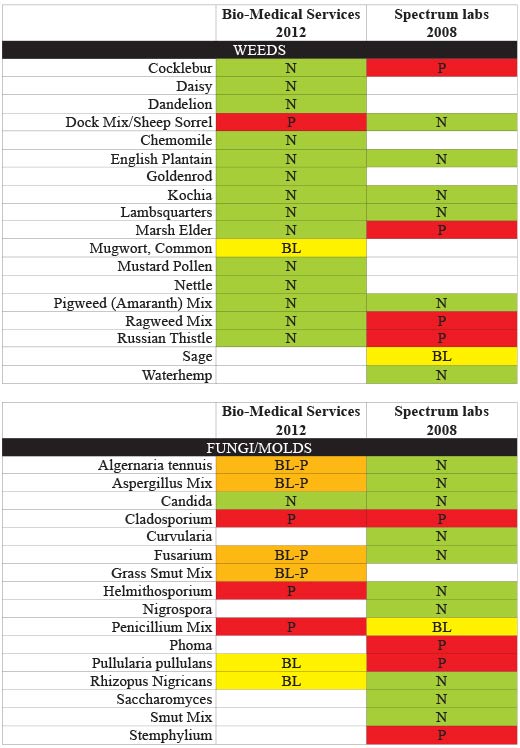

I can see how Jasmine might have not been allergic to something in 2008 and be allergic to it now. But how about the other way around?
Could she had been strongly allergic to something then and not allergic to it at all now?
To me, that is a mind bender. To our vet also. So what now?
On the other hand, this new test would be more in line with what we’ve observed and believed, such as that Jasmine does not have a problem with grasses. For example, previously she tested positive for allergy to Timothy grass, which also happens to be her favorite grass to nibble on. Perhaps this new test is right after all. I’m sure Jasmine would know better than seek something that doesn’t agree with her.
Questions to ponder
Comparing those results begs some questions:
- was there a mix up in a lab in either case?
- is one of the tests less accurate and if so which one?
- which ones in the trees, grasses and weeds section would have to have seasonal symptoms only?
If we can confirm there was no mix-up, somehow we have to decide which test we trust.
And if we do trust the new test, we need to figure out what kind of exposure there can be. For example, there are plenty of ash trees and poplars around; I don’t think, however, I’ve ever seen a walnut or black willow anywhere. Which begs another question, how could be Jasmine allergic to something her body never saw?
Related articles:
Allergies in Dogs: Common, Commonly Misdiagnosed, or Both?
Further reading:
Does Your Pet Have Allergies? Skip the Shots and Try Sublingual Immunotherapy