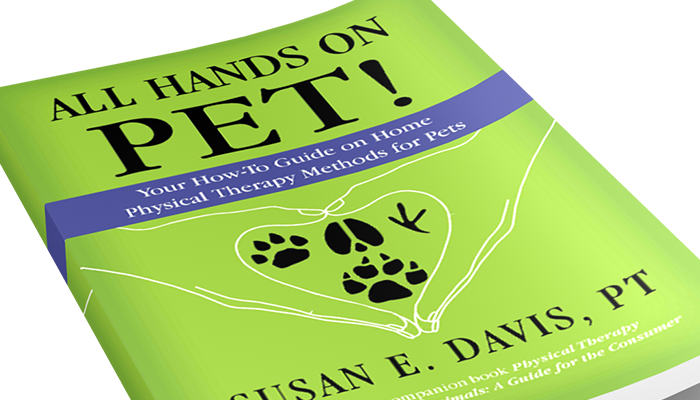
All Hands on Pet: My Foreword to Susan Davis’ Book on Physical Therapy
What do you think of when you hear the words physical therapy?
If it sounds like work, it is. The benefit however far outweighs the effort you put in. And even though your dog needs to do much of the work, it will require dedication on your part as well. If your dog is recovering from an injury or surgery, though, nothing can replace physical therapy to help restore them to full function.
It will stick
“If you keep making that face it will stick.”
Have you ever been told that when you were a kid? Did your face stick that way? Did it? What if I said it only depends on the amount of time you’d spend making that face?
An adaptive system
A body, whether dog’s or human’s, isn’t a machine with an immutable form and shape. Rather, it is an adaptive system designed to respond to challenges it faces. Muscles grow being put to work and atrophy when not used. Bones get stronger with the amount of g-force they are challenged to withstand. That’s why astronauts come back from the weightless environment with depleted bone strength. Even something as underestimated as posture can have a profound effect on function and health.
Any daily activity, or lack thereof, communicates to the body in which ways it needs to adjust. Such adjustments can be either beneficial or detrimental. And if the challenge exceeds the body’s capacity, it results in an injury. And all this time we’re talking about a normal, healthy dog.
Compensation
If there already has been an injury, or a chronic condition that interferes with normal function, the overall impact is even higher. To function, the body will compensate for the weakened parts, taking on the additional strain elsewhere. Many of these compensations might not even be apparent until things break down. Similar to the Jenga (name of the game?) game, you can take out a whole bunch of pieces before the structure collapses.
Where does physical therapy come into all this
Physical therapy is the taking of control over the outside stimuli to maintain or restore balance and health. Physical therapy is a way of talking to your dog’s body, telling it to “stop making that face or it will stick.”
For many years now, physical therapy has been my go-to strategy to help my dogs recover from injuries or surgeries. When the balance in the body is lost, it is ever-crucial to help restore it. No amount of drugs can do that in themselves. No surgery can have a successful outcome without it.
The importance of pain management
Though pain management is a cornerstone of getting anywhere because as long as there is pain, the body will not be convinced to use the part that is hurting. Ironically, though, not using it is likely to cause more pain and you might find yourself in a vicious circle going nowhere.
Taking care of the pain, taking care of the parts of the body that had been carrying the additional burden to compensate, and helping the weak part regain function are all equally important. Where full health cannot be restored, physical therapy becomes about supporting the function as it were as well as helping the body cope with the challenges.
Injury prevention
One thing I myself failed to realize until recently, is how important the role of physical therapy can be in prevention of injuries or chronic issues. It wasn’t until Cookie’s series of injuries when I realized that we should have been working with her body for it to be able to withstand Cookie’s spirit. Especially since, as we learned, she did bring baggage from her past in the form of an old pelvic injury and one hind leg being longer than the other.
She was young and enthusiastic, and healthy or so we thought. Without anybody noticing, one piece of the puzzle stack was being taken out after another until the structure crumbled. We used regenerative medicine and physical therapy to get Cookie well again, and we now use it preventively as well.
Think of it as modulation
Rather than simply physical therapy, it might be better to think of it as physical therapy and modulation. It’s time we all start seriously thinking about how the body works and what physical challenges our dogs confront every day, whether in sickness or in health.
Movement is life
To a dog, movement is life. For my dogs, being able to go out, hike, run, play, or chase things, has always been what made them the happiest. While recovering from her injuries, Cookie did enjoy various tricks, games, and puzzles we did together. But it was obvious that no amount of such activities was as good as ten minutes of chasing after critters.
Regardless of your dog’s physical condition, physical therapy is a way to help them to enjoy as much as possible, and as well as possible. Physical therapy will help your dog to maintain or regain the joy of movement.
For more information see Sue’s website www.joycareonsite.com.
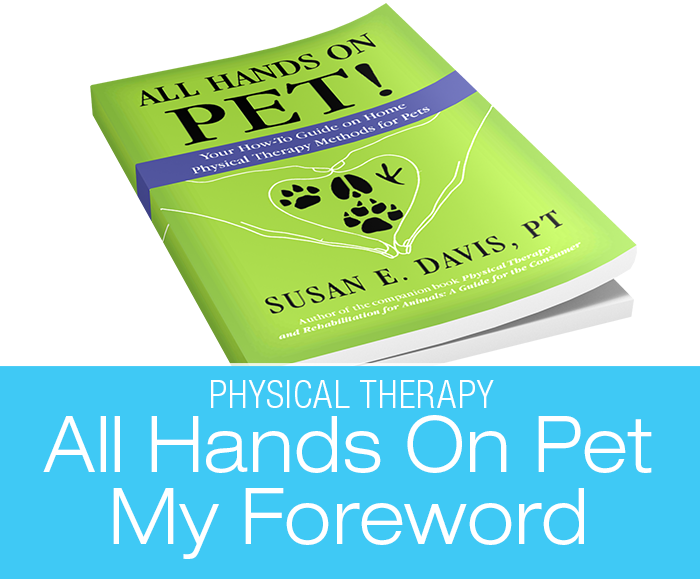
All Hands on Pet! Your How-To Guide on Home Physical Therapy Methods for Pets offers safe and effective actions pet owners can apply through the animal’s entire life spectrum. Information provided applies to multiple species: canine, feline, avian, exotics and farm animals (non-equine).
- Includes 38 photos with directional arrows, plus informative explanations in an approachable style
- Fills the gap where the demand for physical therapy services for pets outweighs the availability of qualified providers
- Cross-references to Physical Therapy and Rehabilitation for Animals: A Guide for the Consumer
- Prudent tips, techniques, and advice typical of that given to author’s own clients
- Real stories of courage from the author’s actual patient caseload
Paperback: 250 pages
Publisher: Joycare Onsite, LLC (12 Sept. 2017)
Language: English
ISBN-10: 0989275027
ISBN-13: 978-0989275026
Books authored by PT Sue:

Physical Therapy And Rehabilitation For Animals: A Guide For The Consumer and
All Hands on Pet!: Your How-To Guide on Home Physical Therapy Methods for Pets.
Physical therapy can do so many great things for your dog. Understanding all the possibilities physical therapy can offer will change your dog’s life. This book definitely belongs on the shelf of every dog lover.
Related articles:
Read Articles by Susan E. Davis PT