
Dog Iliopsoas Injury Diagnosis: Figuring out What Might Be Going on with Cookie’s Legs
Diagnosis is a process. Sometimes, figuring out the reason for your dog’s mobility issues can be quite a journey.
Most of the sinister reasons why Cookie’s legs weren’t working the way they should were more or less ruled out. We were awaiting the appointment with an orthopedic specialist hoping that we’ll get some definite answer(s).
Appointment with an orthopedic specialist
The specialist examined Cookie thoroughly.
She translated our description of the events as Cookie not being able to get her hind legs under her. In retrospect, that could be an excellent way to describe it. It is important from a diagnostic point of view.
Diagnostic manipulations
During the physical examination, both iliopsoas muscles were sensitive touch and particularly to stretching Cookie’s hind legs backward.
On that note, the stretching of the legs was causing Cookie enough pain to cry, yet the vet went on doing what she was doing.
I was taken aback and didn’t really know what to do about it as it wasn’t clear whether it was or was not necessary for the diagnosis. I stood there, screaming inside, praying it’s over sooner rather than later. The vet finished just when I was going to make her stop.
Is pain warranted to achieve a diagnosis
Knowing now what the diagnosis is, I DO NOT feel it was necessary. Jasmine’s vet diagnosed the same type of injury on Jasmine without causing any pain whatsoever.
I will not allow this to happen ever again, that’s for sure.
Apparently, such things happen often with orthopedic surgeons. I don’t find it acceptable. Jasmine’s vet is not a specialist but is able to diagnose things just by feeling the resistance and subtle signs of pain. He never made Jasmine cry no matter what the diagnosis was except when her neck was bad and she cried even when nobody was touching her.
I feel I failed Cookie by having allowed that.
In retrospect, if we just made the trip back South to see Jasmine’s vet we could have had the diagnosis without causing pain to Cookie. Next time we should probably just do that.
Rectal exam to diagnose lameness?
Besides that, the specialist did a rectal exam to feel for pain in the lumbosacral spine, fortunately, there was no pain there other than the obvious pain in the butt. There were no signs of any back pain, no neurologic deficits in any of Cookie’s limbs, and no issues with her joints. All joints checked out. That we’re all good news.
Working diagnosis
The diagnosis was suspected bilateral iliopsoas injury.
The specialist used the term suspected because I guess MRI would be needed to confirm that conclusively.
She said Cookie was going to have been on strict rest for one to three months. Whoa. Cookie is a dog who needs three hours of exercise and play daily. Because we did feel she should be taking a bit easier since the last event, we cut down to two hours and she was already bouncing off the walls at that! I expressed to the specialist that this was not going to happen unless Cookie was sedated.
Chemical restraint
It didn’t seem to surprise her much and she recommended a medication to use for that.
I will write about the medication later. I avoid using drugs for my dogs with all my might but I knew that without some chemical help Cookie was going to be frustrated, miserable, depressed and out of control– a complete danger to herself. She needed help to remain at peace with the sudden lack of activity because the main part of her treatment was to be strict rest.
I also agreed on short-term NSAIDs until we were going to work out an integrative approach with Cookies primary vet.
Chiropractic care
The specialist agreed that it will be good to continue with Cookie’s regular chiropractic treatments.
Typically, iliopsoas injuries come secondary to another orthopedic problem. In Cookie’s case, this would be the situation at her pelvic region.
She recommended a physiotherapy consult which we had already all planned. I was very happy to find out that by leaving our old place we didn’t leave the possibility of hydrotherapy. There is a place up here, at a reasonable distance, which does physical therapy and has an underwater treadmill. It’s about an hour and a half drive each way but that’s not really that much further from how far we normally travel(ed) to any of our vets.
Strict rest for Cookie
The diagnosis made sense to me. The needed treatment–strict rest, nearly broke my heart for Cookie.
But we gotta do what we gotta do to get her back to doing what she loves.
Cookie’s primary vet was kind of surprised by the diagnosis, unfamiliar with this issue. That’s not too strange, many vets are not familiar with this and it’s rarely diagnosed. Rarely diagnosed, though, doesn’t mean a rare condition.
The specialist is quite confident that not only the physical exam but the presentation match this diagnosis quite well.
Thinking about it armed with this knowledge it is adding up.
What are iliopsoas?
What the heck are iliopsoas muscles?
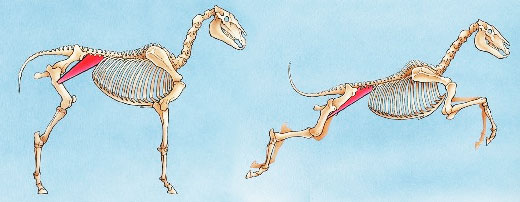 |
| I’ve looked at tons of pictures but all of them make it hard to really picture how the muscle goes. This genius depiction by massagetherapy.com keeps the illustration very simple and awesome. |
Iliopsoas muscles are also referred to as hip flexors or groin muscles. Their main function is to flex the thigh at the hip joint. In other words, they work when the leg moves forward toward the body. Which would explain why with this injury Cookie would have a hard time getting her legs under her.
There isn’t much good literature on this type of injury in dogs.
But Jasmine’s vet is familiar with it, and through Jasmine so were we.
This injury is most typical in sporting and working dogs. But Cookie works at least as hard as an agility dog, probably harder, particularly given the terrain she runs through. Overall, it’s all adding up to this diagnosis.
So that’s what we’re working with now.
Related articles:
Canine Iliopsoas Injury: A Common Undiagnosed Injury in Dogs
Transient Dog Mobility Issues: Figuring out What Might Be Going on with Cookie’s Legs—The Process
Canine Iliopsoas Injuries Symptoms: Sometimes You Don’t Even Know What You’re Looking At—Cookie’s Hind Legs Transiently Fail To Work
Further reading:
Dog Lameness – Causes and Treatment of Limping in Dogs