
Why Trim Dog Nails: The Domino Effect of Untrimmed Nails
Nobody likes trimming their dog’s nails. However, it’s okay to cheat. You can teach your dog to use a scratch board, or have a professional take care of it. However, skipping trimming entirely and letting those nails grow unchecked can trigger a cascade of health problems.
We have just adopted a new girl. It was destiny that she should become part of our family. She needed to be re-homed quickly, and good new parent candidates were few and far between. We are seniors. So we didn’t think we could get another Rottie unless we found a mix that was very small.

This girl is perfection. She is super sweet, lovely, and weighs 60 pounds at 2 years of age. Knowing that she’d be small, it still shocked us how tiny she is when we met her.
The next shock, however, wasn’t so pleasant—her nails were a disaster.
The little girl is young, vibrant, and full of energy. She has quickly earned the nickname Pocket Rocket. Watching her zoom around with those nails made me shudder—it was a mishap waiting to happen. On the other hand, we weren’t brave enough to try and tackle them ourselves. The first day the weather allowed, we took her to our long-time PT to help. All we could do was to start the process—cut as far as it was safe. Now we have to wait for the quick to recede to cut again … until the nails are a healthy length.

Immediate Risks of Untrimmed Nails
While the long-term toll on the body is a slow burn, untrimmed nails pose some immediate threats.
- For example, those extra-long nails act like stilts. They make slippery surfaces like tile or ice hard to grip. This raises the risk of slips, falls, and sprains.
- Additionally, long nails easily catch on carpets, rugs, or sidewalk cracks. This leads to painful rips, breaks, or splits. These cause bleeding and instant limping.
- If nails curl under, they can dig right into the paw pads, causing pain, puncture wounds, and infection risk.
The bigger problem of chronically long toe nails
I could see that with our little Pocket Rocket—the long nails made her stance and movement unnatural to accommodate.
Dogs are actually digitigrade animals. They walk on their toes like ballerinas dancing en pointe. Their heels stay elevated off the ground. This creates that agile, springy gait.
When nails grow too long, they act like unwanted extensions. They hit the floor prematurely. This forces toes to splay outward or twist sideways for proper contact.
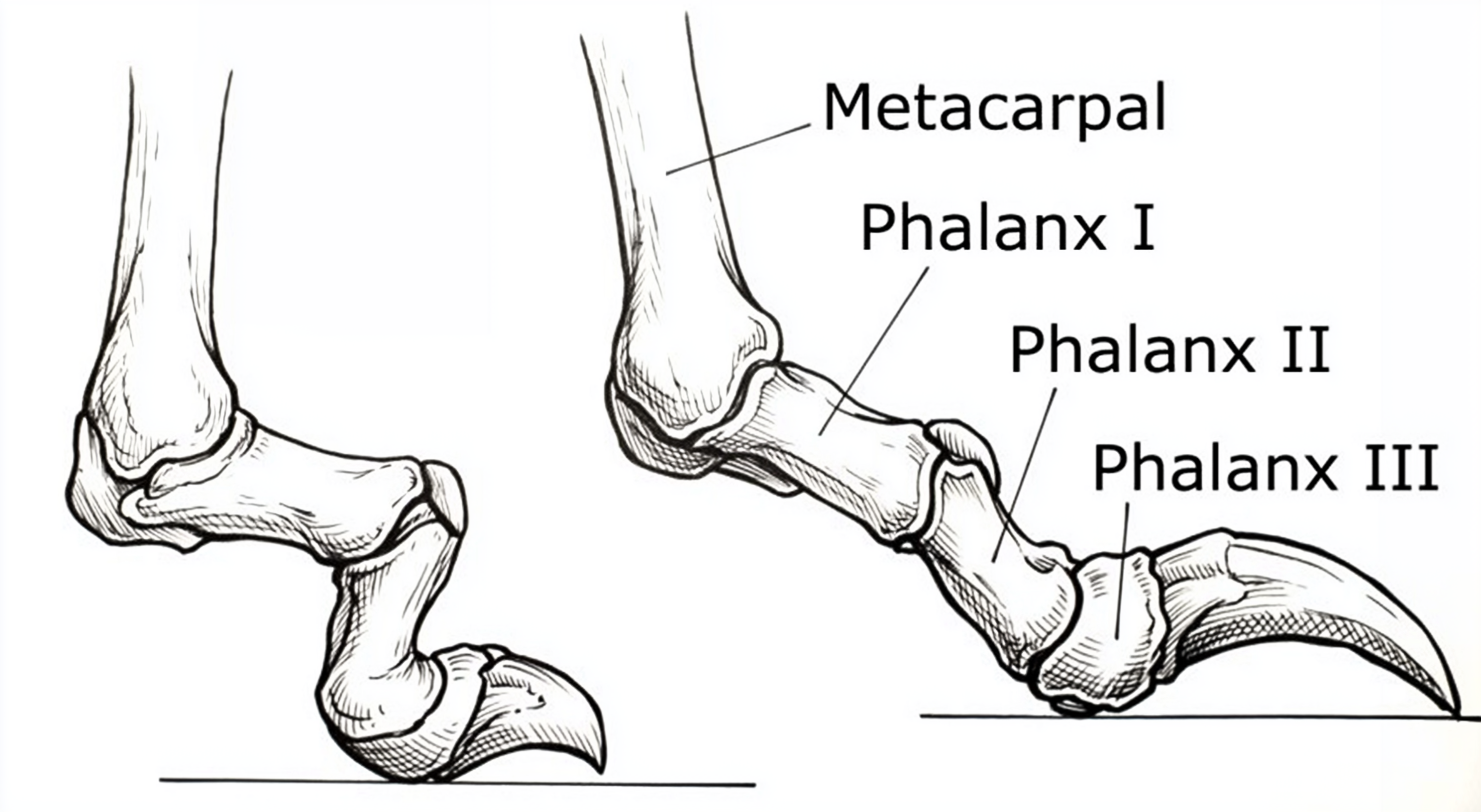
Therefore, this doesn’t just affect the toes. It pushes the entire foot backward. This shifts weight onto the heels and pads. It’s a compensatory effort to maintain balance.
Over time, this backward shift alters the dog’s overall posture. It can lead to a “rocked-back” stance. Here, the front legs angle unnaturally. The back hunches to compensate. Consequently, that puts undue stress on the spine, hips, and shoulders—like wearing ill-fitting high heels that throw your whole body out of whack.

How Overgrown Nails Affect Posture. Source: Animalia World
In addition, this stance can flatten the paw. It throws off joint alignment. The body compensates in ways that cause long-term damage.
As I watched our Pocket Rocket, it was painfully on my mind.
Long toenails, proprioception and compensation
Long nails disrupt a dog’s proprioception. This is their sense of body position in space. They send mixed signals to the brain about ground contact and gravity balance. The dog adjusts its stance. It often adopts a “goat on a rock” posture. Front legs shift backward. Hind legs tuck under the body.
Moreover, this isn’t just awkward—it’s a recipe for chronic misalignment. The toes bear unnatural pressure. It radiates up through the wrists (carpus), elbows, shoulders, hips, and even the spine. This creates a chain reaction of stress. Meanwhile, this altered gait and posture can accelerate wear and tear on the joints.
You might be aware that compensation for an injury or other problem can lead to further injury. But while not as obvious, long toenails can lead to the same domino effect.

Why Trim Dog Nails: The Domino Effect of Untrimmed Nails
Untrimmed nails can potentially trigger a cascade of mechanical changes …
Joints
Hips and Elbows
For dogs already predisposed to conditions like hip or elbow dysplasia—genetic issues where joints don’t form properly—overgrown nails act like an aggravating factor, amplifying pain and reducing mobility by forcing compensatory movements that further irritate the malformed joints.
While long nails don’t cause dysplasia outright, they can mimic or exacerbate its symptoms, leading to earlier onset of secondary arthritis in the elbows or elsewhere.
Shoulders and Knees
But the impact doesn’t stop at hips and elbows; overgrown nails ripple through the entire skeletal system. The altered gait shifts weight backward, overloading the shoulders (scapulohumeral joints) and stifles (knees), which can lead to inflammation, cartilage breakdown, and conditions like shoulder instability or patellar luxation over time.
Hocks
Even the hocks (ankle joints) in the hind legs bear extra torque, increasing the risk of sprains or degenerative changes as the dog compensates for the unstable foundation.
Spine
Spine involvement is another sneaky consequence—the unnatural posture often arches or hunches the back to maintain balance, putting chronic stress on the vertebrae and intervertebral discs.
This can result in back pain, muscle spasms, or even disc herniation in severe cases, especially in breeds prone to spinal issues.
Jaw
Even the jaw can be indirectly involved, as poor posture might lead to tension in the neck and changes in how the dog carries its head, potentially contributing to temporomandibular joint issues over time.
Ligaments
Soft tissues take a hit too. The unnatural angles strain tendons and ligaments, which are the connective tissues holding everything together. For instance, the extra torque on the legs can overstretch ligaments in the knees or elbows, raising the risk of tears like those in the cranial cruciate ligament (similar to an ACL injury in humans).
And speaking of related soft tissue woes, let’s not overlook the carpus (wrist area)—overgrown nails can push the toes upward, creating unnatural angles that overload the carpal ligaments, leading to chronic strain, hyperextension, and even potential tears if the stress builds up.
This hyperextension happens when the ligaments stretch too far, causing the wrist to sag or bend backward excessively under weight, which might start as subtle soreness but can turn into full instability without intervention. And that triggers its own domino effect.
Muscles
Muscles aren’t spared either; some groups, like those in the shoulders and back, become overworked to maintain balance, leading to strains, spasms, or even chronic muscle imbalances that weaken opposing areas.
Over months or years, this can result in reduced flexibility, making your dog more prone to pulls or injuries during play or simple movements.
What is the optimal dog toenail length?
There is a simple rule of thumb for knowing when your dog’s nails are at a healthy length. You shouldn’t hear them clicking on hard floors when your dog walks normally.
If there’s that telltale “tick-tick” sound, it’s time for a trim. The nails are too long and starting to alter their gait. Ideally, the nails should just barely touch the ground when the paw is flat. This allows for natural toe-off. It prevents forcing the toes to bend or splay.
This keeps everything aligned and prevents the domino effect from kicking in.

Why Trim Your Dog Nails: Summary
Overall, a minor oversight can snowball into big problems. These range from immediate injuries to lifelong orthopedic challenges. It all happens because the foundation—the paws—isn’t stable.
We entrusted Pocket Rocket’s nails to our trusted team at Touch Animal Rehabilitation, and they got us started safely.
Are you ever going to look at your dog’s overgrown nails the same way?
Long nails force an unnatural gait and posture. They shift weight and alignment. This affects areas from the toes up through the legs, hips, shoulders, and spine. This constant misalignment accelerates wear on joints, potentially worsening conditions like arthritis or dysplasia by adding extra stress and inflammation.
Absolutely—beyond joints, they strain tendons, ligaments, and muscles. For example, extra torque can overstretch carpal ligaments. This leads to hyperextension. It can also cause muscle imbalances in the back and shoulders from compensatory movements. Acute snags can also tear skin or pads right away.
It depends on your dog’s activity level and nail growth, but aim for every 1-4 weeks. If you hear clicking on hard floors, they’re too long. For our Pocket Rocket, we’re doing gradual trims every couple of weeks to let the quick recede safely.
You’re not alone—it’s okay to “cheat”! Use a scratch board for self-filing, or visit a groomer or vet. We took Pocket Rocket to our PT for her first trim since her nails were so bad. Professionals have the tools and know-how to avoid the quick.
Watch for limping, splayed toes, reluctance on hard surfaces, paw licking, or changes in posture like a hunched back. Immediate signs include slips, breaks, or bleeding; long-term ones might be stiffness or irritability from ongoing discomfort.
Further reading:
Trimming your pets nails
Nail Trimming in Dogs: Tips & Best Practices for Better Health
A Dog’s Toenail Length Matters
Further education:
Dr. Buzby’s DIY Dog Master Course: Nail Trimming Without Fear
Proprioception & Postural Reactions
Related articles:
The Importance of Nail Trimming: What’s The Most Common Problem I See In My Canine Patients?
Nail Injury in a Dog: Keep Your Dog’s Nails Trimmed—Bubba’s Lameness
I did not know that the impact of neglect (because that’s what I believe it is) could be so severe. I am glad you wrote this because sometimes people genuinely do not realise that long nails can harm a dog, and maintenance is essential.