


If your dog’s poop looks like somebody just had a birthday party in their belly, somebody did. Those polka dots on your dog’s poop are cooties… in other words, parasites!
Unfortunately, your dog’s polka dot stool will not look as cute as in this illustration.


How fresh is the poop?
If the pie isn’t freshly baked, the worms might not have come out of your dog’s bum. They might have just shown up after the party’s started, so to speak. I have seen freaked-out people sharing photos of worms that invaded their dog’s poop after it’s been on the ground for a while, and I have seen that happen now and then, too; guests showing up for an open buffet.
It is also possible that your dog ate something that didn’t digest well, and that’s what you’re seeing. Some foods don’t digest, particularly when eaten whole. However, you might need to freak out if you see rice-like things in your dog’s poop or around your dog’s rear end. They’re probably tapeworms.
Which worms can you see in your dog’s poop?
You have a leg up if you see worms in your dog’s poop. Because only two of the four common intestinal worms can usually be seen in the stool; tapeworms and roundworms.
Tapeworm
Once you’ve seen the tapeworm segments, you will recognize them.


If a tapeworm is a worm, why does it look like rice? Well, it doesn’t until it does. They look like worms inside your dog’s body, but they shed body segments as part of their life cycle. When the segments first appear, they are small, white, and may even wiggle. But as they dry, they shrink up into what looks like rice. I saw a couple of them crawl right out of Cookie’s bum and then experimentally watched one shrink.
Cookie most likely got them from eating a squirrel with fleas. An ingested flea is the most common way dogs get tapeworms.

Roundworms
Roundworms look more like what you’d think of a worm looking like. Long and, well, round. Unless your dog has lots of roundworms, you probably won’t see any in the poop. But, just because you don’t see any doesn’t mean they’re not there.


Roundworm; 2-3 inches
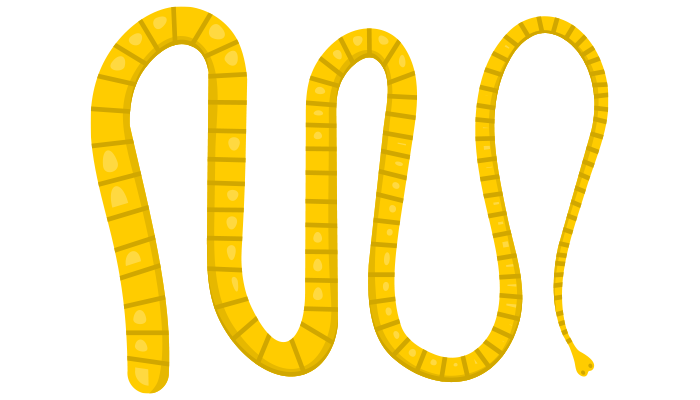
Tapeworm; ~8 inches

Other symptoms to watch for
You may or may not be able to tell whether your dog has worms by other symptoms, such as:
- diarrhea
- vomiting
- a pot-bellied appearance
- weight loss
- or dry hair
That said, I am not a fan of treating a problem I don’t have; I wouldn’t routinely deworm my adult dog. I do, however, have the poop checked regularly. Worms are not only gross but severe enough that infestation can be dangerous.
Intestinal versus environmental visitors
Before you automatically freak out, finding creepy crawlies in your dog’s poop, consider how long the poop was sitting outside, too. Perhaps your dog eliminated at night, and in the morning, you find your dog’s poop covered in creepy crawlies.
While polka-dot dog poop often screams parasites, sometimes the crawlies didn’t come from your dog’s belly at all.
There are environmental visitors attracted to the poop buffet once it hits the ground. Dog feces are rich in nutrients. They decompose fast and release odors that attract insects from afar. I have seen partridges and even butterflies feasting on my dog’s poop!
Timing and appearance are key to telling them apart.
Immediate invaders
(Seconds to minutes)
Flies (house flies, blow flies) are usually the first responders—they can smell fresh poop from hundreds of meters away and swarm it almost instantly.
Beetles or hornets might follow suit within minutes, drawn to the scent for food or egg-laying spots.
Short-Term crawlies
(Hours later)
If poop sits out, flies lay eggs that hatch into tiny white larvae (maggots) in as little as 8-24 hours in warm weather. These might look like wriggling specks but aren’t parasites—they’re external decomposers. Slugs or ants could also appear, especially in damp or shaded areas.
Medium-term visitors
(1-2 days later)
As decomposition ramps up, the poop becomes a hotspot for more diverse critters.
Maggots grow larger and begin breaking down the material, creating a moist environment that attracts beetles (e.g., dung beetles burrowing in) or small flies that lay additional eggs.
In humid conditions, free-living nematodes from the soil—microscopic or short (a few mm) thread-like worms—might migrate onto the surface, feeding on bacteria. These look like slim, wriggling specks but are harmless environmental decomposers, not internal parasites.
If you spot this, it’s usually not from your dog—check fresh samples to avoid confusion.
Long-term decomposers
(Days to weeks)
Over longer periods, the poop fully breaks down into soil-like matter, blending with the environment and attracting ground-dwellers like earthworms (thicker, 2-5 cm juveniles that might poke through) or more nematodes integrating from nearby dirt.
Fungi, or mold, may sprout, producing white threads that resemble worms at a glance.
In warm, moist environments, this occurs within 3-7 days, turning the site into a mini-ecosystem.
These didn’t originate from your dog but are opportunistic in the surroundings. Earthworms, for instance, are attracted to organic decay but appear bulkier than parasite segments.
Polka dot stools in dogs: Summary
Internal parasites like tapeworm segments emerge with the poop and may wiggle briefly when fresh (think: alive and mobile for minutes), but they dry out quickly into immobile, rice-like grains.
Roundworms are longer and noodle-like if visible.
Environmental bugs crawl onto the poop later and often move independently. If it’s not fresh (e.g., left out for 30+ minutes), those extras are likely outsiders.
If you want an accurate picture of your dog’s poop quality and content, examine it right away.
Specific vulnerabilities
While any dog can pick up intestinal parasites, leading to polka-dot stools, certain ages and breeds are at higher risk due to immature immune systems, genetic predispositions, and environmental factors. Recognizing these can help you stay extra vigilant with your pup’s poop checks and preventive care.
Puppies and young dogs
Young dogs and puppies are particularly vulnerable because their developing immune systems are less robust, making it easier for parasites such as roundworms or tapeworms to establish infection.
Puppies often inherit roundworms from their mothers (transplacental or through milk), leading to heavy infestations that might show as visible spaghetti-like worms in poop or vomit.
Young dogs explore more (sniffing/eating contaminated soil or feces), increasing exposure. Symptoms hit harder too—pot-bellied appearance, stunted growth, or diarrhea with specks— so fecal tests at every puppy vet visit are crucial.
Breeds Like German Shepherds
GSDs and similar working breeds (e.g., Collies, Rough-Coated Collies) have a genetic predisposition to conditions such as EPI and immune sensitivities that can exacerbate parasite burdens, including roundworms.
Their active, outdoor lifestyles amp up environmental risks (e.g., contact with infected wildlife or soil), leading to higher infestation rates.
Genetics plays a role in weaker resistance to certain worms, so visible polka-dots might signal recurring problems. For these breeds, annual fecal exams and flea prevention are non-negotiable, especially in rural or multi-dog homes.
Share your polka-dot stool story

Related articles:
What’s in the Poop?
A Primer On Intestinal Worms: Types, Symptoms, and Diagnosis of Intestinal Worms in Dogs
Further reading:
Internal Parasites in Dogs
Intestinal Worms in Dogs and Cats