


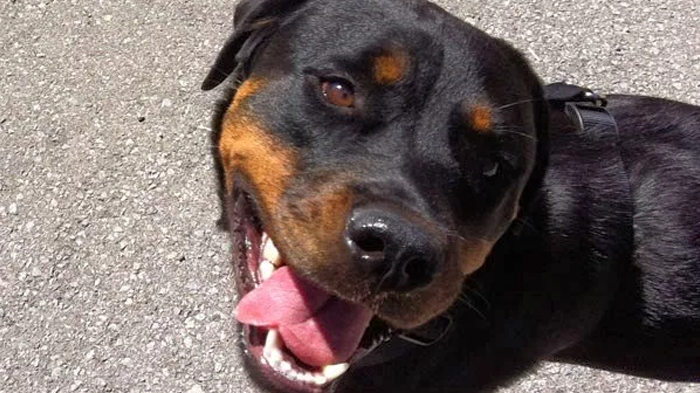
I get that nobody likes playing with puke. But if your dog does throw up, examining what came out can be quite useful.


And for a fresh real-life example?
Cookie’s leg had been sore off and on (more on that later), and our vet recommended giving Tylenol for the time being. I was not thrilled with the idea, but yesterday there was a good reason to give some.
I gave her one yesterday afternoon and one in the morning.
Cookie threw up a few hours later.
The first thing I’d suspect was the Tylenol. But I decided to examine the vomit anyway. At first glance, it just looked like a thick chyme kind of thing.
Scrutiny, though, revealed small pieces of wood!
That paints a different picture, doesn’t it?
Cookie tends to chew on whatever happens to be nearby, which happens to include sticks and wood chips. So we were watching her and trying to prevent her from actually eating any of that.
Clearly, somehow she sneaked some by us anyway.
In her defense, Bruin and JD used to do the same thing and quite regularly would throw up a pile of wood pieces after a day at the farm. (one of the main reasons we got insurance for JD) One can watch them only so much.
JD stopped doing that. Hopefully, Cookie will, too, before it bites her in the rear end.
She’s looking good and eating and pooping normally, so I’m hoping she threw up all that didn’t belong into the system.
It’s always a good idea to examine the puke.
Cookie, honey, please stop eating sticks.
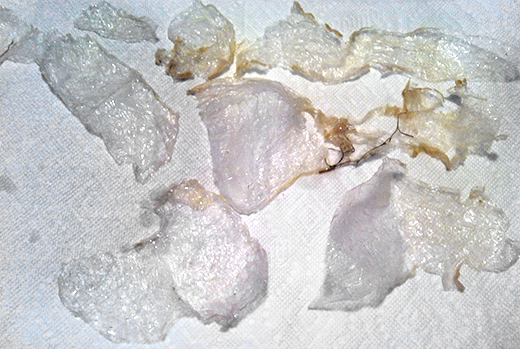
When JD threw up the other day, I examined the vomit, as usual, looking for pieces of wood. It all seemed quite normal, except for some strips, which seemed like chicken strips but were so strong that they couldn’t be pulled apart. When washed and “unwrapped,” it turned out to be saran wrap.
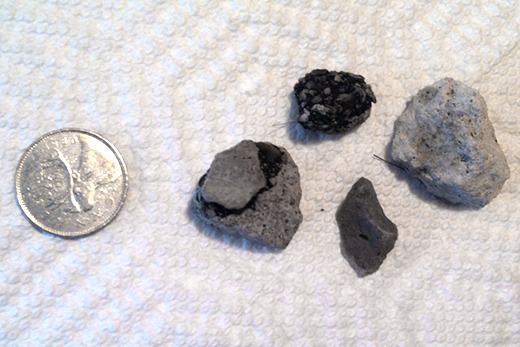
The vomit containing these rocks looked quite inconspicuous, too–until closer examination. (I added the coin for scale)
The complete list of things that don’t belong in the stomach and my dogs threw up overtime includes:
- dead mouse
- sock
- pieces of a toy
- pieces of a dental chew
- small rocks
- small sticks
- bone fragments
- grass
- horse poop
- food packaging
- partridge feathers and entrails
So why examine your dog’s puke?
There are two main reasons you want to know what your dog’s puke contains:
- to learn what your dog is into to prevent them from eating that
- to assess whether what they ate came all out or whether there could be more stuff left in the GI tract
If you’re lucky, the inedible object(s) make their way back out on one end or another. But if they don’t, you might have a more serious problem on your hands. If your dog continues being ill, you will need to involve your veterinarian.
Some things are dangerous because of their size and shape; some might be poisonous.
They ate what?
Dogs eat or swallow the strangest things. Often, it is a mystery they survive. However, the issue is so common that Veterinary Practice News has an x-ray contest where veterinarians share radiographs of the strangest things they discovered in their patient’s stomachs!
Want examples?

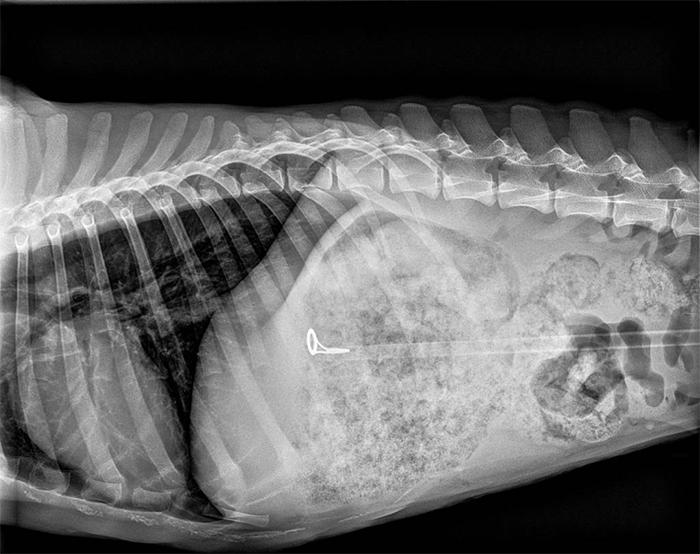


When I look at some of these things, I can’t even imagine how the dog got it down, such as a kitchen knife.
Further reading: 15 X-ray images of items dogs have swallowed but shouldn’t have….
Did your dog ever throw up anything strange?
Related articles:
My Dog’s Vomiting