


Do you have a first aid kit for your dog? Or do you think that you don’t need one?
No matter how carefully you try to keep your dog safe, injuries and unlucky incidents happen. The situation doesn’t need to be life-threatening for you to benefit from having a first-aid kit on hand.


I established a first-aid kit for my dogs for the same reason I take an umbrella when I don’t want to get wet, regardless of the weather forecast. Did you notice it often won’t rain just because you have one [an umbrella]? And if it does, you’re ready for it.
Information I recommend to include
Wherever you are, the first thing on your checklist should be the contact information and directions to a veterinary clinic and veterinary ER. This is particularly important when you travel but you would be surprised to know how many people don’t know where to turn in an after-hours emergency even where they live.
Imagine trying to find an emergency veterinary hospital when you’re already in the midst of an emergency. It would be extremely stressful and a waste of precious time.
When we travel, I always map out clinics along the way and at our destination.
Having an animal poison control phone number handy is also a good idea. I keep the contact for the Pet Poison Helpline 800-213-6680
If you do travel, don’t forget to take your dog’s medical records with you too. If your vet uses web-based medical records, even better. That way you can access the information any time, anywhere.
We also always make sure we have all Jasmine’s prescription medications and supplements to last us for the length of the trip (and like to have some extras just in case). Besides medications Jasmine is on I like to include some metronidazole (in case her IBD flared-up), Tramadol (for pain management), and couple prednisone tables. That is kind of funny because I fight putting her on that tooth and nail but it still makes me feel better to have some just in case. Note: I would never use any of these without discussing it with Jasmine’s vet first.
How equipped do you want your dog’s first-aid kit to be?
Naturally, what you can have in your dog first kit at home varies from what you can bring when you camping, hiking or hunting. It reminds me of George Carlin’s stand-up about stuff and how you need to keep downsizing as you leave home for a holiday, then your hotel for a party and so on.
On the other hand, when you’re camping, hiking, or anywhere away from home you need to realize that your first aid kit is often what you need to rely on. Things you could easily run out to get in town can be hard to come by in the field or a bush.
The bare basics
At the very least, your dog’s first-aid kit should contain the following:
- bandages or bandaging materials
- a non-stick sterile wound dressing
- blunt-tip scissors
- tweezers
- sterile saline
- rubbing alcohol
- 3% hydrogen peroxide
- water (if traveling or hiking)
- betadine
- styptic powder
- rectal thermometer
- lubricating jelly
- corn syrup
- clean syringe (without needle)
- muzzle/restraints
Extended version
An extended first-aid kit should also include:
- activated charcoal
- antibiotic ointment
- Benadryl
- tick removal tool
- old credit card (this is for removal of stingers)
- protective gloves
- flashlight
- towel or rag
- cotton roll
- gauze roll
- gauze pads
- self-adhesive bandage e.g. vet wrap
- splint
- toenail trimmer
- blanket
- cold and hot packs
- supportive harness or stretcher if you have a large dog
Dog first aid kit for camping
For camping, I recommend you pack the extended version–it is best to cover all your bases. And absolutely don’t forget to pack your dog’s medications and medical information in your dog first aid kit for camping. As well that you best locate the nearest veterinary clinic and how they have it set up in case of after-hours emergencies.
Dog first aid kit for hiking or hunting
It is one thing to pack a large kit and load it in a car, it is another to carry it in your backpack. Give thorough consideration to where you’re going, what are the regional and seasonal risks, and how far from civilization you’re going. There are things you might be able to omit.
What is in our kit?
Our home first-aid kit grew over time to a huge amount of things. As well as since we moved to the middle of nowhere, we had to revisit its content. For example, normally one or two rolls of bandaging material would be plenty. But, as we learned, getting stretchy bandage or vet wrap around here is not easy. So we had to increase the amount of these things we keep on hand.
Things that we used the most
Tick removal tool
We got the TickTwister and never looked back. Of course, there are other products out there, just make sure you have something to remove ticks safely.
Thermometer
Ever since Jasmine’s drug-induced hyperthermia disaster I have been acutely aware of how important this vital sign is.
Personally, I have both an ear thermometer and a rectal thermometer. I realize that the ear one isn’t the most accurate thing but we found that the average of multiple measuring corresponds with what the rectal one reads. So I use the ear thermometer to get a rough picture and the rectal thermometer when the situation warrants the accuracy.
Lubricating jelly
Cannot use the rectal thermometer without good, water-based lubricating jelly. You want to take your dog’s temperature, not injure them.
Betadine
Betadine solution has been my go-to for minor foot infections. Jasmine had them frequently enough. It comes in handy for disinfecting other types of minor wounds. It is safe and it doesn’t sting.
Antibiotic ointment
While I list it as an ointment, which would normally mean products such as Polysporyn which we did use in the past, I now stock raw Manuka honey. It is amazing how well it deals with infections.
Sterile saline
Some of the content of our first-aid kit laid dormant until we got Cookie. Sterile saline comes in handy when she manages to get something in her eye, such as a blade of grass. That took a lot of salite to wash out but I didn’t want to try going at it mechanically. Eventually, it worked and we flooded it out.
3% hydrogen peroxide
This is another item I kept periodically replacing unopened until Cookie came into our lives. In her defense, I only had to use it to make her throw up once when she managed to eat something that could possibly have been a pot brownie.
Rubbing alcohol
No, I have never used rubbing alcohol on wounds–I keep it on hand in case my dog suffered hyperthermia.
Syringe
We used a large syringe when Jasmine had to be force-fed. It is also the best delivery tool if you need to give your dog peroxide to induce vomiting.
Bandages and bandaging materials
We never needed any of these things until we adopted Cookie either. My favorites are stretchy bandages and vet wrap. It is also important to have non-stick sterile wound dressing to prevent your bandage from sticking to the wound. I stock other bandaging supplies but didn’t need to use those yet.
Scissors
Blunt-tip scissors are needed to cut the bandage when you are applying it. If you use vet wrap, though, you can set it so it is easy to remove without cutting. I don’t like scissors close to my dog’s body even if the tips are blunt.
Benadryl
Yes, all our dogs got stung often enough that I have to use Benadryl at least once a year.
Muzzle
Even the most mild-tempered dog can bite when in enough pain. So far we only used it for PROM exercises during the first weeks of Jasmine’s post-ops.
An improvised muzzle can be made from a scarf or a stocking.
Supporting harness
Having Rottweilers, this is a godsent item. It is really helpful when your large dog cannot walk just like JD couldn’t before he passed on.
My dog first-aid kid has a lot more item than these but I wanted to highlight those we used most frequently. I keep a bunch of things that I, fortunately, never had to use.
What does a veterinarian-designed first aid kit contain?

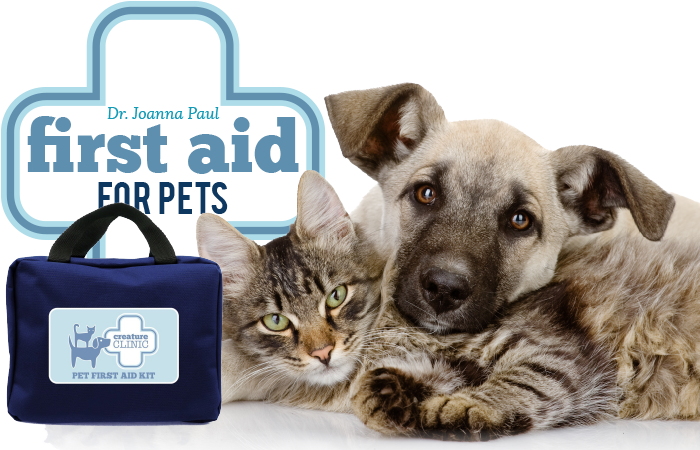
The kits I’m using as an example come at two sizes–for large dogs, and for small dogs and cats. The compact bag easily fits almost anywhere and it is loaded with everything you might need to help your pet in an emergency situation. It comes complete with a useful booklet that tells you exactly how to best deal with any medical emergency you might face with your pet.
An example first aid kit put together by a veterinarian contains:
- pet first aid manual
- bandage scissors
- forceps
- iodine (50 ml)
- sterile saline flush (20 ml)
- 10 ml syringe
- digital thermometer
- single-use lubricant
- cotton balls
- gauze swabs
- melolin non-adhesive dressing
- orthopedic padding (cotton wool bandage)
- elastic cohesive bandage 5 cm
- elastic adhesive bandage 5 cm
- antibiotic ointment
- disposable gloves
- gauze length for muzzle
- lectade (oral rehydration solution)
- thermal blanket
- tick remover (2 sizes)
- extra leash
What’s in Your Dog’s First Aid Kit?
Related articles:
Dog Symptoms: When Is It an Emergency?
Further reading:
How to Make a First-Aid Kit for Dogs