


Inflammatory bowel disease is a syndrome caused by an immune reaction to chronic irritation of the GI tract.
The cause is poorly understood but the result is immune cells infiltrating the tissues of the gastrointestinal tissues. The common theorized causes are chronic parasites, bacterial infections, or food allergies.
Symptoms can vary in severity but commonly consist of chronic vomiting, diarrhea and loss of appetite.
Further reading: Inflammatory Bowel Disease in Dogs


Jasmine’s story
Ever since Jasmine came to us she was having bad stools.
It wasn’t bad diarrhea, and it didn’t seem to have affected her in any way, so at first, we figured it might have been a response to change and that it would sort itself out. She was still on the same food the breeder was using.
Days were passing by and it wasn’t sorting itself out.
Seeking veterinary help
Off to the vet we went.
They checked her out, analyzed her stool, everything was negative. Armed with antibiotics we returned home. Her stools improved. Yay, problem solved! At least so we thought.
A couple of days after she finished her medication the bad stools returned.
And our saga of frequent vet visits that never lead to anything began.
After seeing Jasmine with the same issue enough times, they switched her to a prescription diet. Not that it had made any difference. Neither did bi-monthly vet visits and seeing a number of different vets. Since the antibiotics would always temporarily help, that was the best idea they would have come up with.
The diagnosis we received
Their conclusion?
Jasmine has a delicate system and that’s just the way it is. That was their official diagnosis. Today, such a diagnosis would make me jump out of my skin.
But back then I didn’t know any better. We took her to the vets, they didn’t find anything, what else is there to do? When her diarrhea got bad, she’d get antibiotics and things would improve for the time being.
Poor appetite
Meanwhile, Jasmine was getting less interested in her food. A dog that is not food driven? Hm, ok then.
We figured that was because the food was so bland. She would accept it when I added a bit of cooked chicken or broth. No harm in that, the chicken was the main ingredient in the food anyway, right?
Apart from the stool and appetite issues she looked and acted healthy and happy. The vets didn’t seem bothered by the situation, so who were we?
Gradual decline is hard to see
The decline was gradual and hard to make too much of it.
From time to time she’d refuse to eat for a day and her stomach would make all kinds of noises. The next day she’d eat normally. That too was attributed to her delicate system, particularly since she loved drinking from puddles which were blamed for the stomach upsets.
New variables
At the age of two, she would have some nights when she would pace around the house, pant and keep asking to go outside. Since eventually, she would produce some runny stool, this also was attributed to her delicate system. At first, it would happen rarely.
She also seemed to have been prone to leg injuries. Three times she’d injured her leg and limp heavily. Nothing was found and we were told that it is probably just a soft tissue injury. Perhaps it was, perhaps it wasn’t. Each time it took several months to resolve, but eventually, it would.
I also noticed that she didn’t like playing with her toys as much anymore.
She used to love playing tug-a-war with me. But now she’d play a little bit and then stop and did what to me looked like licking inside of her mouth. Another vet visit and again sent home with there is nothing wrong with her mouth.
Since there was nothing wrong with her mouth, when she lost interest in her chew sticks, we figured that she outgrew that.
Acceptance?
I mean, how many times can one take their dog to a vet and get sent home with either there is nothing wrong or that’s just the way she is?
So … she had a delicate system, was prone to soft tissue injuries and there was nothing wrong with her mouth or otherwise…
Since none of these things really seemed to have been affecting the quality of her life—she looked happy and enjoyed her walks and play with her fur buddies—perhaps there really wasn’t anything wrong?
Wax and wane symptoms
Her stomach upsets would come and go, so would her episodes. I felt that there was something going on, but what else can one do than taking her to the vet?
A couple of times she’d get a hot spot on her cheek. That got treated and went away.
In the summer she’d get a flaky skin – attributed to drying slowly after a swim, so we started taking a towel and drying her thoroughly. That seemed to have been helping.
Symptoms are getting worse
By the time she turned five, her episodes had increased in severity and frequency.
Visit to a vet. No diagnosis. Another visit to a vet. No diagnosis …
Eventually, it got so bad that I simply declared that neither she or myself can go on like this. We are going to a vet and not leaving until he figures out what this is because it is something! In desperation, the vet decided to test her thyroid. It came back positive, her thyroid levels were extremely low.
Hypothyroidism diagnosis
Ok, great, we got some diagnosis!
She was put on thyroid medication. Her thyroid levels stabilized and her episodes also subsided. I was quite happy that finally, we have solved at least one of the problems.
Or have we?
We knew something wasn’t right but we didn’t know what and the frequent vet visits weren’t providing any answers or solutions, other than temporary relief.
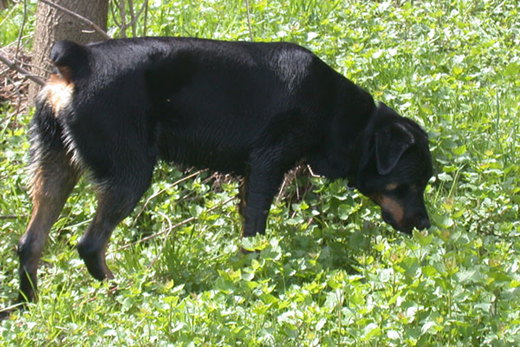
Jasmine’s stools were mostly soft and often loose.
Usually, though, she didn’t go to the bathroom more frequently than would be normal. We thought that was a good thing since she went only two to three times a day. We thought it wasn’t really diarrhea, just loose stools.
That would go on for a while, followed by frequent potty calls during the night.
No clues from testing
That was usually when we went to the vet, yet again. Jasmine’s blood work wasn’t showing any clues.
At least that was what we were told. I never saw those results then and I wouldn’t have known what I was looking at if I did. Stool samples didn’t show anything either, not even the elaborate “collect tiny bits of poop into this container for a week” giardia testing.
Did she actually have giardia at some point? None of the tests showed anything.
The baffled vets prescribed antibiotics, time and time again.
The antibiotics did help. Jasmine’s stools would firm up after a couple of days of taking them and remained firm throughout the treatment. Sometimes even a while after the treatment. And then they would start softening again.
At that time we had a lawn in our yard. But trying to clean the loose stools from the grass was a major challenge. Between that and the fact that Jasmine’s urine would systematically kill the grass, we decided to give up on the lawn and covered the yard with wood chips instead. That made it easier to keep the yard clean.
Stomach upsets
Slowly but surely Jasmine was getting pickier and pickier with her food.
She started refusing her breakfast altogether. Which would be fine, I guess, except the times when she was yet again put on antibiotics which she was supposed to take with a meal, and yes, in the morning too.
She really didn’t want to have anything to do with food in the morning. I imagine her belly was feeling crappy. Getting the antibiotic without a meal would make her feel even crappier.
We tried embellishing her food, offering yummier stuff. But she just didn’t want to eat.
One thing we could almost always rely on was, that for some reason, she always felt better once she got out on a walk. So in order to get her to accept a meal to go with her meds, I’d get up at five in the morning and take her for a walk. After that, she did eat and could get her meds safely.


Temporary patch, not cure
As time went on, it became more and more obvious that the antibiotics were only a temporary patch.
Knowing what I know now, I would have done things very differently. But back then, all I knew was to take my dog to a vet.
Jasmine’s relationship with food kept deteriorating. Often she wouldn’t want her dinner either. Her belly would start making all kinds of noises and she’d refuse even the yummiest treats, such as boiled chicken breast, even steak.
The only thing that seemed to always work was a good long walk.
Sometimes she’d throw up some bile, sometimes she wouldn’t. But about halfway through the walk to stomach got quiet and she started being interested in treats.
Refusing food
Eventually, Jasmine wouldn’t even consider touching dog food.
I got a premix and was adding home-cooked meats just to get her to eat at all. And still no answers.
Most of the time, other than her disinterest in food, things didn’t really seem to affect her quality of life. She loved her walks, she loved to play, she looked happy. Other than the days when her stomach was clearly not feeling well.
Those times she’d be visibly uncomfortable, drooling and wanting to eat grass. Yet, even on those days, a good long walk seemed to help almost every time.
No weight loss
She wasn’t losing weight. At least not as far as anybody could tell. She was muscular, energetic and full of zest for life. Perhaps I did manage to get enough nutrients into her after all.
And probably also one of the reasons why the vets weren’t taking this seriously enough. I can’t believe that this has gone on for five years without a diagnosis.
I would have never let things go on for so long now. But back then I just didn’t know better. When the vets kept saying that she just had a sensitive system, I accepted it at that.
Today I would most certainly want to know WHY.
The missed answer
If her system was sensitive, why? Sensitive to what? There is a reason for everything. Where there is smoke, there is fire. And there literally was a fire in her belly.
I was happy to finally have a diagnosis. I was not happy that it took so long. And even then it was mostly a coincidence. Looking for a vet certified in stem cell therapy, finding one who wanted to x-ray her whole body and in the process of discovering the problem.
If your dog is having any kind of a chronic problem, do insist on definite answers.
There IS an answer to everything. It’s just a question of finding it. No diagnosis is as scary as having a problem that keeps getting worse and nobody knows what to do about it.
However long it took, Jasmine’s diagnosis came before things got REALLY bad.
Yes, I believe it was at the root of a number of other problems, but it never brought her to the brink of death. And IBD can get that bad. You can go and read Leroy’s story to learn how horrible IBD can get.
Relatively mild, chronic problems are the worst.
If your dog is really in trouble, having life-threatening symptoms, it is an incentive to get answers. But if the problem is coming on slowly, doesn’t really seem so bad, it begs to be dismissed. Don’t.
Insist on answers
Don’t dismiss the problem and don’t let your vet do that either.
“A man can get used to anything; even a noose,” my granny used to say.
But that doesn’t make it any better for him. And it doesn’t make it any better for your dog. It makes me think of the frog and boiling water scenario again.

Just because he doesn’t know he should jump out, it doesn’t mean it won’t kill him.
Yes, all the experiences with Jasmine made me very paranoid about any warning signs I might see in my dogs. But I do believe that it is better to be too paranoid than not paranoid enough.
Living with an IBD dog
Over time we adjusted and learned to live with Jasmine’s belly upsets, fussiness about food and stool problems. What other choice did we have?
If I could go back in time, knowing what I know now, things would had been different.
But back then, since all the visits to a number of different vets didn’t bring any solution, we thought that things were the way they were.
The belated diagnosis
It wasn’t until we were dealing with a different issue altogether when we finally got some answers.
That summer Jasmine injured her hind leg. Again. It looked the same as the three times before, so we figured that it would go away with restricted exercise as it did in the past.
When we took her to a vet, were always told it was some type of soft tissue injury.
It always did take quite a long time to resolve. But I couldn’t bring myself to patiently waiting again. Jasmine still liked her walks, but if she had a choice she’d rather rest instead. That wasn’t like her. Even though we didn’t expect a different answer, I insisted that we take her to the vet anyway.
She was diagnosed with a torn cruciate ligament. We saw an orthopedic specialist who confirmed the diagnosis and TPLO surgery recommended.
I researched the subject until I was blue in a face. Our feeling was that we’d prefer a non-surgical solution if possible. We weighed a lot of options from braces to prolotherapy. When I learned about stem cell therapy, I was sold. Jasmine’s vet at the time never heard of it and wasn’t eager to learn about it either. We went searching for a vet certified in the procedure to discuss this option.
Getting a second opinion
That’s how we found Jasmine’s new vet.
He was on board with the idea. He examined Jasmine and wanted to have additional x-rays to see her shoulders and hips too. We agreed that he’d take as many additional x-rays as he felt were needed.
While he was doing that, he decided to take advantage of Jasmine being under and do an even more thorough physical exam.
An abdominal mass
We got a call from his office that he wanted to take more x-rays than originally agreed on. He wanted to take x-rays of her abdomen. He had felt a mass.
Abdominal mass?! Our hearts sank.
The abdominal x-rays confirmed his suspicion. There was definitely something there showing up as a mass.
We had a long talk with him in his office. Whatever it was, perhaps we caught it early. He suggested blood tests to see where to go from there.
The blood looked good.
An exploratory surgery
He suggested an exploratory surgery as the next step. Take a look at what it was in there and take it out if possible. We agreed to do that.
When he opened Jasmine up, there didn’t seem to be any tumor but something infiltrating the tissue of the stomach and small intestine. There was enough infiltration that it felt looked like a mass on the x-rays. He did a biopsy and sent it off to the lab.
We had to wait five days for the results.
If you ever waited for biopsy results, you know that the five days felt like years. We were in shambles. How could this be? What if it really is cancer? What should we do then?
Finally, the results came back and it was not cancer!
Instead, it was white blood cells (eosinophils) infiltrating the tissues. Jasmine had Inflammatory Bowel Disease (IBD). Eosinophilic gastroenteritis to be more exact. Which was a result of Jasmine’s long-term food allergies which never got diagnosed.
Finally, we had an explanation for all her digestive problems. And all it took was five and a half years of vet visits and a busted knee to get it.
Related articles:
Symptoms: Recognition, Acknowledgement, And Denial
Inflammatory Bowel Disease in Dogs: Why I Dislike IBD
Diagnosing IBD in Dogs: New Way to Diagnose Canine Inflammatory Bowel Disease (IBD)?
Further reading:
Inflammatory Bowel Disease in Dogs