


The tibial plateau leveling osteotomy (TPLO) surgery is considered the mainstay treatment for cruciate ligament tears in dogs.
The purpose of the surgery is to stabilize the knee joint by altering the joint anatomy, namely the tibial plateau angle. Is TPLO a good option for your dog?


Introduction
It’s been over ten years when I first heart the term. When my Rottweiler, Jasmine, received the diagnosis of a partial cruciate ligament tear, the veterinarian gave us one option—TPLO. I had no idea what any of that meant.
When I returned home, I turned to research to figure out what I just heard at the vet office. After learning what a CCL injury is, I realized we had to do something to address the problem. But after looking up what TPLO is, I didn’t like it at all. Now, years later, I still don’t like it.
Further information on CCL injuries: Talk To Me About Dog ACL/CCL Injuries
What to know about TPLO
The rationale behind TPLO is that leveling the tibial plateau provides stabilization to a stifle with a damaged CCL.
If you take a look at the bones of the canine knee joint, you can see the point—considering the stresses it has to withstand, the dog knee looks like a flimsy joint, doesn’t it? It looks like those two tiny ligaments are all that is holding it together. While that is not so, once the CCL is lost, the joint does become lax with the thigh bone (femur) sliding forward where it should not.
Such instability causes pain and leads to arthritis.


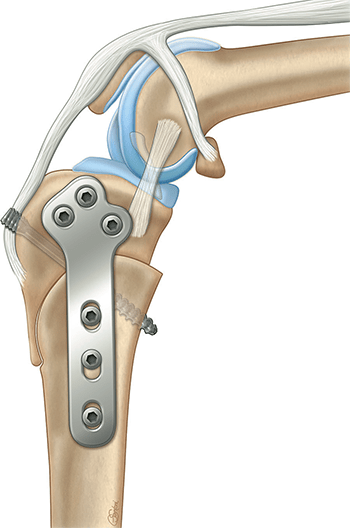
The TPLO aims to give the femur a more level platform to sit on, prevent it from excessive movement. That is achieved by cutting and repositioning the top portion of the shinbone (tibia) to create a more level surface to prevent forward sliding.
Once I saw how it is done, that’s where they lost me. I’m supposed to do this to my dog?


What I hated about the procedure
There is no doubt the TPLO is an invasive procedure, and I haven’t shown any photos of what the leg looks like after the surgery. It involves cutting and repositioning of a bone and inserting hardware to hold it all together.
When I look at the schematic, I can’t believe that this could ever work. Is the resulting spike going to break off or poke at tissues? Is the hardware going to split the bone? Can this stay in place and heal?
Further, because this surgery requires a circular cut in the bone, it generates a lot of heat which can burn the bone surface which delays healing.

Argument for selecting TPLO
In spite of all that, TPLO has a good track record.
- bones heal amazingly well
- it has a good record of stability post-surgery
- it has a good record of return to normal function post-rehabilitation
The repair is strong enough that a dog can function even when they need surgery on both stifles—bilateral surgery.
One of the main advantages of TPLO is that it is a procedure that most veterinary surgeons are most familiar with. Practice makes perfect; a track record and comfort level the surgeon has with a procedure does make a difference. You don’t want the surgeon to practice a new—however fantastic—surgery on your dog. At least I wouldn’t.
Recovery expectations
Many dogs start using the injured leg within a day post surgery, especially with adequate pain management. Within two weeks, your dog will bear some or full weight on the leg and by ten weeks most dogs don’t have a visible limp.
Pain management during and after stifle surgery is critical.
Tammy Hunter, DVM
After a six month rehabilitation period, most dogs return to normal function and physical activity.
To facilitate successful recovery, it is essential to obtain a detailed post-op rehabilitation plan from your surgeon and follow it.
Further information :Example post-op recovery plan
Don’t forget that no surgery can have good results without physical therapy.
Further information: Canine Post-op Recovery: Don’t Forget the Physical Therapy
TPLO complications
Any major intervention in the body brings the potential of complications. It is true for any surgery.
Even though anesthesia protocols are increasingly safe, it is essential to be aware that a degree of risk is always there.
Immediate complications with TPLO surgery include:
- swelling, bruising, and seromas at the incision
- poor incision healing
- infections
- slow healing where the bone was cut
- meniscal tears
- implant failure
- tibial fracture
- fibular fracture
Long term complication which can happen at any point after surgery involves infections at the implant site. If that happens, the hardware has to be removed.
Further information: Complications of Tibial Plateau Leveling Osteotomy in Dogs
Why consider TPLO?
There are many options for the treatment of a torn CCL in dogs. Doing nothing, however, is not one of them. Without treatment, the knee will remain unstable, painful, and increasingly arthritic. Over time, the problem will escalate to loss of quality of life and significant loss of function. Further, compensatory injuries follow.
Which option is best for your dog depends on a number of factors, such as:
- level of the ligament damage (partial or full)
- size and weight of your dog
- age and activity level of your dog
- your dog’s tibial plateau angle
- availability of alternative options
- other considerations
Would I select TPLO for my dog?
I might, depending on circumstances.
For a partial tear in otherwise fit dog, I give first consideration to regenerative therapy. I keep updated on surgical options for dog knee injuries. If my dog had a full ligament rupture and surgery was the best way to go, I’d give higher consideration to some of the alternate options depending on their availability.
For example, I consider Cora-based Leveling Osteotomy (CBLO) a superior update to the TPLO. Instinctively, I am a fan of the Triple Tibial Osteotomy (TTO), but availability in my country is poor. I am intrigued by the Simitri Stable in Stride stabilization.

In closing
When it comes to cranial cruciate ligament tears, doing something is better than doing nothing. TPLO is a vialable option with good tract record.
I recommend you research all options and then make a decision. Your surgeon can assist you with the selection process or you might need to surgeon-shop.
I put a lot of thought to such decisions, weighing pros and cons of each approach.
Related articles:
Dog CCL Injury Grading: Cruciate Tears “All or None, or Partial?”
Cora-based Leveling Osteotomy: My Two Cents on (CBLO) Repair
Triple Tibial Osteotomy: My Two Cents on TTO Cruciate Repair
Simitri Stable in Stride Stabilization
Further reading:
Cranial Cruciate Ligament Repair: Tibial Plateau Leveling Osteotomy (TPLO)