



Ruptured cruciate ligaments are a common injury in large breed dogs but small dogs can hurt their knee too.
In small dogs, the injury can sometimes resolve with conservative management–rest and medication.

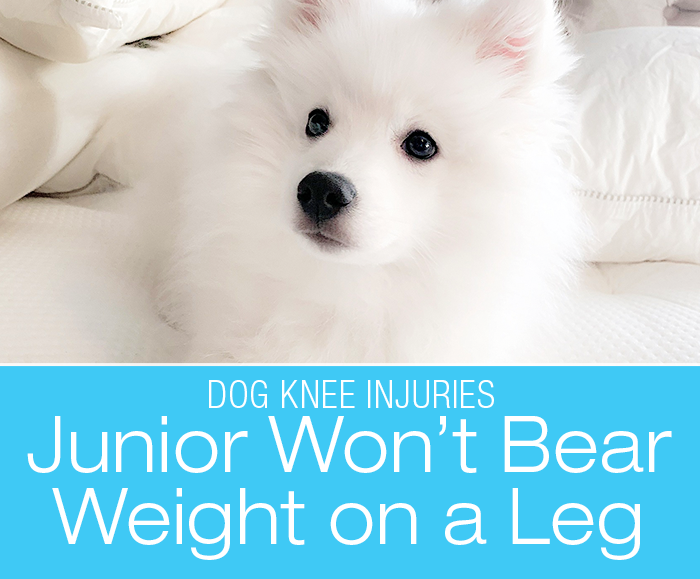
Junior’s story
Junior is an active, nimble senior dog–a little rocket. Age didn’t slow him down much.
During one winter,t though, he suddenly stopped using his left hind leg; hopping around on three instead. When it came to stairs, his dad had to carry him.
At first, Junior’s dad thought that because of Junior’s age, arthritis was bothering him. Some days the leg was better, some days it was worse. This went on for about a month. Perhaps Junior should see a vet after all, even if just to get some medication to manage the suspected arthritis.
At the veterinarian
The veterinarian examined Junior thoroughly. Lameness can have many different causes. An unhappy joint could do it but so could other issues.
Starting from Junior’s toes and working his way up to the hip, Junior’s veterinarian didn’t meet any resistance which would indicate pain from touch or manipulation. His reflexes were flawless as well which ruled out neurological causes.
It was testing for joint stability which revealed the root of the problem. Junior’s left knee was unstable and wobbly.
The diagnosis
Further examination and x-rays confirmed cruciate ligament rupture.
With age, the chances of cruciate ligament damage increase because of gradual degradation of the tissue.
In large dogs, surgery is often the best way to deal with the problem but small dogs can sometimes respond to conservative management.
The treatment
Junior’s dad decided to give the conservative management a try.
Original story:
Junior, a twelve year old Japanese Spitz dog who stopped putting weight on his left hind leg
Related articles:
Why Is My Dog Limping? Causes of Lameness in Dogs—Symptoms To Watch For In Your Dog
Talk To Me About Dog ACL/CCL Injuries
Further reading:
Nonsurgical treatment of CCL tears