


How can one evaluate whether their tick preventive is working?
You can have expectations about product efficacy based on scientific studies, personal belief, or the presence or absence of ticks on your dog. While all the other measures are great, the last one is the only one that matters.
The market is full of various tick-preventive products of all kinds. Some of them are officially endorsed, some come with anecdotal evidence, and some are outright dangerous.
First, do no harm
While I am concerned about tick-borne infections and my goal is keeping my dog pest-free, safety is my primary priority. Unfortunately, with our dogs’ history of adverse drug reactions, which include reaction to Canine Advantix, I don’t want a repeat of any such thing.
Of course, that is not to say that natural products are all harmless, especially if used improperly. Which is why I spend a good deal of time deciding on safe tick prevention for my dog.


Essential oils
Essential oils and blends are a popular solution. You can buy products that are ready to use or you can find an assortment of recipes.
In the past, we tried some of these things to repel mosquitoes. The best one kept them at bay for about 20 minutes before it needed to be re-applied. Therefore, that leaves me rather skeptical about their efficacy.
More importantly, though, my current dog, Cookie, cannot stand the strong smell. It doesn’t matter which blend it is—the strength of the fragrance drives her out of her mind. While it might or might not keep Cookie tick-free, it increases the risk of injury from the resulting zoomies.
Further reading: 4 Natural Flea & Tick Repellent Recipes For Your Dog
Tick tag
We used a tick tag for couple of years. Whether the tag did or did not do anything, I was happy:
- it didn’t bother my dog in any way
- my dog had no tick during that time
Does the absence of tick on my dog during our use of the tag mean it worked? Maybe. Or maybe
- we have very few or no ticks that would go after dogs on our property
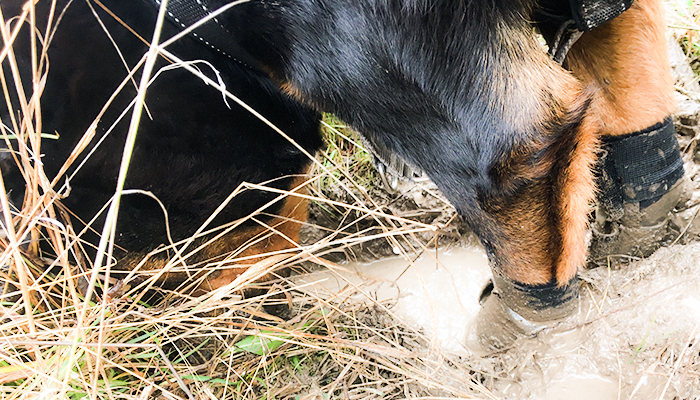
- my dog didn’t get any ticks because she spends most of the season hunting frogs, and there are no ticks in ditches and puddles
- my dog has been healthy, and the notion that these parasites only target sickly animals is true
The only way for me to evaluate the efficacy of the tag would be having two identical dogs doing identical things in identical places—one wearing the tag and the other not wearing one.
Interesting note
One of my primary concerns was the fact that moose in our area suffer with severe tick infestation. As I learned from our veterinarian, though, the ticks that target moose aren’t interested in dogs. Did you know that?
Either way, Cookie had no ticks and I was happy. Except the product became unavailable and I had to get back to the drawing board.
Further reading: Tick Prevention in Dogs Experiment: Ticked Off at the Tick Situation—Tick Tag Results Evaluation
Ultrasonic repeller
While we were happy with our results, we had to switch to something else. I came across a new product—an ultrasonic tick repeller. Can something like that work? The odds are it should be just as successful as the tag was.
What I like about this product:
- it is also a tag, only a bit bulkier than the one we used in the past
- it is chemical-free
- amazingly, it is made in the EU, which is a bonus
- it can be used for both humans and pets
Potential downside is that unlike the last tag that was weather-proof, this one cannot get too wet.
What is the theory behind it?
It emits a series of ultrasonic pulses that disrupt ticks’ and fleas’ senses and stops them from detecting humans and pets. It is non-toxic and does not use or release any chemical substances or odors.
tickless.ca
Does that mean that ticks use some sort of sonar to hone on their meal? Aren’t they supposed to smell it?
Apparently, the organ ticks use to find their host is a unique structure called Haller’s organs. According to literature, the Haller’s organs are olfactory sensors. Ticks can detect scent and the slightest movement of their target.
Can ultrasonic pulses interfere with the detection? According to the University of Camerino it can.
Do I buy it?
Maybe. I don’t know enough about it and couldn’t find a good source to learn more. However, I decided to try it and go from there. If we started finding ticks on Cookie, we’d have to revisit our measures.
Related articles:
Canine Tick-Borne Diseases: The Ticking Bomb
Tick Prevention in Dogs Experiment: Ticked Off at the Tick Situation—Tick Tag Results Evaluation
Tick Prevention for Dogs: What Do You Use for Tick Prevention?
Further reading:
Natural Home Remedies for Flea and Tick Control