


Sometimes, a missed diagnosis can come at the ultimate price. Would Duke be still alive if he was diagnosed early?
If your dog is not improving with treatment, either the treatment or even the diagnosis might be erroneous. Don’t wait to seek answers. Insist that your veterinarian gives you an outline of your dog’s treatment response. Don’t ever walk out of your veterinarian’s office without having all the information you need—grab your free Veterinary Visit Checklists.

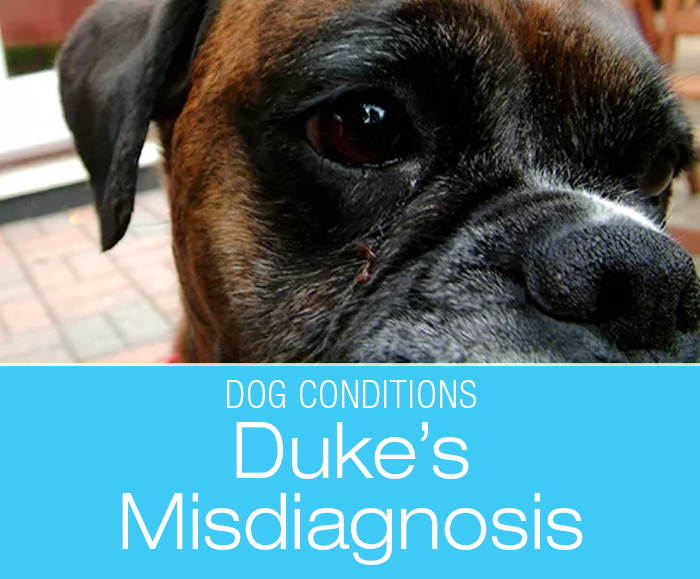
Duke’s story
Here is the stumbling block with diagnosing—the obvious problem might not be the one you’re looking for. How would you figure out that the condition your veterinarian identified is not what is causing your dog’s symptoms?
Duke was 7-year-old Boxer. He was a happy, active dog, enjoying life to its fullest. Until he wasn’t.
Duke’s symptoms included:
- lethargy
- weight loss
- hind end lameness
- back pain
The problem with most symptoms is their ambiguity. Just about any illness can come with lethargy or weight loss. Back pain and lameness are a little bit more specific but do they always mean a musculoskeletal problem?
The diagnosis
The veterinarian examined Duke, ran some labs and took x-rays. He found problems with Duke’s spine and diagnosed him with spondylosis.
Spondylosis is a degenerative condition which results in abnormal growth of bone tissue on the vertebrae. Even though the condition is not inflammatory, such as arthritis, it can cause pain, stiffness and restricted motion. It is particularly painful when the bone spur pinches on a nerve.
Source: petMD
Duke’s x-rays did show spondylosis in his spine. Enough pain could cause lethargy and reduced mobility could lead to muscle loss. The explanation seemed to fit the picture.
The treatment
The veterinarian prescribed treatment for spondylosis. However, it was not helping. Duke continued to lose weight. His entire body, not just his hind end, were literally becoming skin and bones. Duke was not getting better, he was getting worse.
He also started drinking enormous amounts of water.
What was happening? Why wasn’t the treatment working? The diagnosis seemed straightforward and made sense. And there was clear evidence Duke indeed did have spondylosis. Surely the condition couldn’t progress this fast and in spite of treatment?
Duke kept declining
Duke could barely get around at all and needed a lot of help. And then his urine started smelling really bad. It was stinky, dark, cloudy and foamy.
That’s when Duke’s parents decided to seek a second opinion. They could no longer believe the spondylosis could be causing all this.
Do you think spondylosis was the correct diagnosis? What would you make of Duke’s symptoms? What would you do if Duke was your dog?
Read Duke’s story to learn what was wrong with him.
Further reading:
Missed Diagnoses: What to Do When You Think Your Vet Is Missing Something