


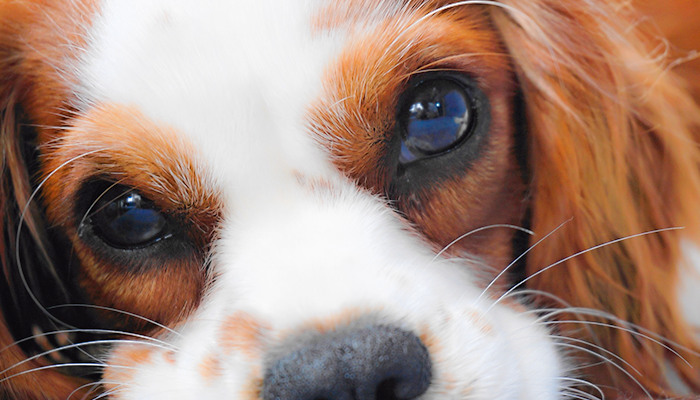
Brachycephalic dog breeds, to which Cavalier King Charles Spaniels belong, are highly susceptible to eye issues, including dry eye.
A healthy eye is continually bathed in tear liquid. That nourishes and protects the eye from debris, irritants, and infections. The big, adorable eyes of Cavalier King Charles Spaniels are naturally susceptible to dry eye simply because of their size.
Often, the eyelids cannot close over the entire eye, causing excessive evaporation.
Other potential causes of dry eye in dogs include:
- autoimmune diseases
- hypothyroidism
- certain systemic infections
- inner ear infections
- certain medications
Further information: Keratoconjunctivitis Sicca (KCS) or Dry Eye in Dogs


Archie’s story
At first, Archie’s eyes seemed red and looked as if their surface was covered by some kind of film. Instead of the bright, sparkly appearance, the eyes looked dull.
As Archie’s veterinarian examined him, he immediately suspected dry eye.
Dry eye is what it sounds like—insufficient lubrication of the eye surface. The increased friction between the eyelids and the surface of the eye causes inflammation, pain, and can lead to corneal ulceration. Further, it makes the eyes more susceptible to infections.
Other symptoms of dry eye include:
- squinting
- excessive blinking
- thick yellowish discharge
- holding the eyes shut
Archie’s diagnosis
Dry eye diagnosis is confirmed by a Schirmer Tear Test. The veterinarian places a short strip of filter paper into the eye and measures tear production over the time of one minute.
A healthy eye produces over 15 mm of tears. Reduced production confirms dry eye diagnosis. In an advanced stages, the eye might not produce any tears at all.
Archie’s treatment
Archie’s dry eye was in early stage. The veterinarian prescribe eye drops in case Archie’s problem was temporary from an infection. Archie’s mom was to apply the drops for a month and the come back for a check-up.
Archie’s follow-up appointment
When Archie came back to the clinic for his checkup, his eye looked and fell better and was almost normal. Did the improvement mean there was no underlying issue?
A new flare-up
Archie was doing well but then his eye started bothering him again. This time he was so uncomfortable, he wouldn’t open his eye more than half way. A new test confirmed Archie’s dry eye problem was back.
Because the specialized anti-inflammatory ointment to restart tear flow is costly, the veterinarian decided to try treat Archie’s problem by regular application of artificial tears. Archie’s problem wasn’t so severe that it wasn’t worth of try—it’s a reasonable first-line measure.
Some dogs might even need surgery to correct the problem.
Archie, however, responded well to the treatment and hopefully might be able to avoid a complicated surgery.
Source story:
Archie is a six-year-old Cavalier King Charles Spaniel
Related articles:
Eye Discharge in Dogs: What Is That Goop In My Dog’s Eyes?
Bulging Eyes in Dogs: When Your Dog’s Bulging Eyes Are Not Normal, And You Should Be Concerned
Further reading:
Keratoconjunctivitis Sicca (KCS) or Dry Eye in Dogs