


When taking care of your dog’s wound, the last thing you want is to introduce a new injury.
I don’t know about you, but I hate the idea of scissors anywhere near my dog’s body. Scissor lacerations can land a dog in an emergency room. You never know when your dog might make a sudden move that will turn the seemingly harmless tool into a weapon.


Using scissors
When we do have to use scissors around our dogs, we use the round-nose kind which we have in our dog first aid kit.
But, still, I wouldn’t say I like using even those.
Every time our dog comes bandaged from the vets, the only way to remove it is by cutting it.
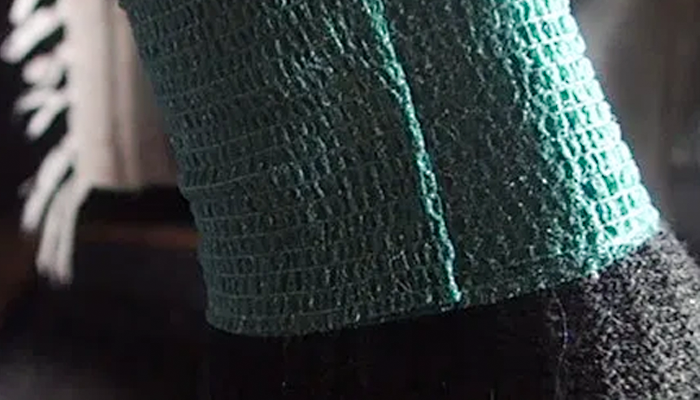
Vet wrap is a marvelous invention that I love. But once it’s been applied for a while, there is usually no way of finding the end and being able to unravel it.
With last year’s Cookie’s cut on her paw pad and this year’s post-op wound after removal of JD’s mast cell tumor, we’ve done our share of bandaging.
Using vet wrap so it doesn’t need to be cut to remove
A handyperson can come in handy.
Hubby is quite a handyman, always making or building something. For example, every time he uses tape, he makes a little tab on the end, so it is easier for him to find and pull off the end when he uses the roll the next time.


make a tab as below.


Tabbing
It was hubby’s suggestion to make a tab at the end when applying a bandage as well.
“I guess I have to go fetch some scissors,” said the vet when JD came to have his post-op wound checked out when she realized we had bandaged a sock over it.
“Nope, you don’t,” said hubby and showed her the tab we made, which is easy to grab so the bandage can be simply unwrapped.
Unlike duct or electrical tape, the end does not stick out from the roll. The tabbed vet wrap still adheres to the rest as it should, but the tab makes it easier to find and pull off.
Not once has JD worked off his bandage because of the tab. Even when he did work off the sock from underneath, the bandage remained in place.

And for some reason, nobody else seems to have ever thought of that. Not when bandaging a wound, not when putting away a roll of tape. And yet, the vet wrap we use comes with precisely the same tab on a new roll.
Having changed bandages three times a day (yes, I’m very paranoid about infections when bandaging my dogs), this little trick is a lifesaver.
Don’t cut it. Tab it.
Related articles:
Canine Wound Care 101: Classification, treatment, and physical therapy
Further reading:
Principles of Wound Care & Bandaging Techniques