


What is socialization and what can it possibly have to do with longevity?


The general belief, it seems, is that socialization is your dog meeting other dogs–as many dogs as possible. Which is true to a degree but far from that simple.
What is socialization?
Socialization is the process of preparing a dog to enjoy interactions and be comfortable with other animals, people, places and activities.
American Veterinary Medical Association
In other words, yes, socialization does involve exposure to other dogs. Not just any exposure, though. And not only dogs. Note the words “enjoy” and “comfortable” in the above quote.
Socialization ough to offer the opportunity for positive encounters. Why? Because it is about your dog making positive–or at least neutral–associations. If the encounters are scary or unpleasant, the whole concept falls apart, doesn’t it?
In a way, the term socialization is misleading. It implies social interactions only. But it is much more than that. Proper socialization is about positive experiences not only with other dogs and people but also objects, places, and situations.
Socialization is about teaching dogs that the many things that they encounter by living with us are okay and nothing to be afraid of. That includes dogs, kids, men with beard, women with carriages, people in wheelchairs, people in funny hats, people with backpacks, traffic, elevators, thunder, fireworks, washing machines, umbrellas, doorbells … All the things we take for granted can be strange, unnatural and scary to a dog.
We learned that these things are okay gradually, growing up. Our dogs need the same opportunity–the difference is that the window to do it is smaller.
The two scenarios that cause stress
The two things that lead to fear or stress in your dog are
- things that previously led to a bad experience
- unknown things
The good news is that the more different positive experiences your dog had, the more likely they are to view new things as an adventure rather than something to fear.
The bad news is that it works the other way as well.
What is fear?
Fear is a negative emotional state triggered by the presence of a stimulus that has the potential to cause harm. That could be something your dog has learned is dangerous, or something your dog doesn’t know it isn’t.
From survival point, if you don’t know whether you should be scared of something or not, being scared is more likely to keep you alive and therefore to live and procreate.
We all experience fear–it’s not a good feeling. Living in fear diminishes quality of life.
That alone would be a good enough reason to help our dogs to cope with the world we placed them in confidently and comfortably.
Forget the unrealistic expectations we place on our dogs. While a fast-moving car, an umbrella or a dishwasher aren’t scary to us, how would the dog know they’re safe unless we allow them to learn that?
Common dog fears and phobias
What are the common dog fears and phobias?
Probably the most common phobia many dogs have is astraphobia or fear of thunder. But it extends further than that. Often it includes any loud, unpredictable sounds such as fireworks, gunshots, and even washing machines or dishwashers.
What about the fear of being left alone? We refer to it as separation anxiety. Do you know how many dogs suffer from this?
Many dogs are afraid of veterinarians or veterinary clinics in general. For some dogs, something as simple as a car ride can be a source of stress.
Then there is fear of strangers, men, children, and even objects, particularly noisy ones.
Yet, there is a way to fix all that. That’s where socialization early in life, or desenzitation, come into play.
It is, however, much easier to teach a puppy, who is still learning what to make of things, that the world is a safe place than trying to reverse emotions in an already fearful dog.
Ok, fine, but what does any of that have to do with longevity?
There is the obvious, of course–the immediate danger. Getting into a fight in a dog park, running away and other behaviors can cause harm or injury.
Or is it that obvious?
For example, thousands of dogs and cats get hit by a car every year. How many of them were poorly trained and how many were running away scared from something such as fireworks? It’s a dangerous world out there for a dog.
Poor socialization, fear and stress
As people, we can consider haunted houses, scary movies, rollercoaster rides, and other scary entertainment fun. But what if your whole life was a scary ride? What if you really had to live in a hunted house? Have you ever been camping and heard sounds in the bush you didn’t know what they were? Have you ever tried going camping after watching the Blair Witch Project? [I have.}


Dogs are not adrenaline junkies like some of us are. And many of them really do live in haunted houses in haunted towns from their perspective. That not only makes their lives a living hell but chronic stress is absolutely not conducive to longevity.
Physiological response to stress in dogs
Behavioral expressions of fear are highly individual. The physiological response, however, is quite consistent.
The fight or flight response triggered in response to a scary situation is useful when it is important to react that way. If it is triggered too often, it exhausts the system and leads to serious changes in the dog’s body. Instead of helping the dog survive, it can shorten their lifespan.
A stressful situation causes the release of hormones to facilitate the appropriate response–fight or flight.
Things that happen in the body in response to stress serve to increase the immediate availability of energy and include an increase in
- blood pressure
- heart rate
- blood flow to the muscles
- cellular metabolism
- blood glucose levels
- blood coagulation
Other processes are suppressed with stress such as
- blood flow to areas not critical to movement
- pain perception
- immune response
- digestion
- cellular repair
- growth
This is all fine and dandy short-term but a body cannot properly function in this state forever.
Trigger stacking
Further, all the above physiological responses are not an on and off switch. What that means that even if the stress triggers were equal, as one follows another the stress levels will not be. That is because it takes quite a while for the body to get everything back to normal.
After cortisol levels spike in response to a stressful event, it can take the body five to eight hours to remove the excess cortisol.
If the dog is stressed again within that time, the newly released stress hormone adds to what was still left in the system from before.
The video below explains this phenomena from behavioral point of view. But the health ramifications are influenced the same way.
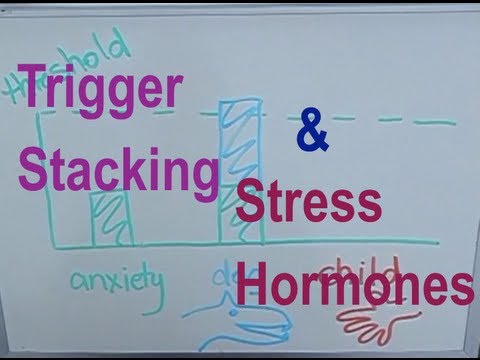
Think of it this way. Imagine you have a pot of cool You put it on the stove and turn the heat on to warm the water. If you do that repeatedly before the water gets a chance to cool back to room temperature, it will become hotter every time you turn the burner on.
What does that mean for you dog?
It means that with enough stressful events during the day, your dog’s stress hormones might never be at normal, healthy levels.
As a result, some of vital maintenance functions might be on hold indefinitely.
For example think of what would happen to you car if you never changed the oil or did any minor repairs?
Physiological signs of stress include
- loss of appetite
- weight loss
- diarrhea
- bowel disease
- weakened immune system and resulting issues such as frequent infections
- higher susceptibility to cancer
- increased inflammation and resulting issues
- delayed wound healing
- worsening of existing health issues
Living in stress shortens lifespan in dogs
Stress caused by living with anxiety or fearfulness has deleterious effects on health and lifespan in canines
Dr. Nancy Dreschel, Pennsylvania State UniversityDr. Nancy Dreschel,
Now, can you see what socialization has to do with longevity? A well-socialized dog will not only have a happier but also a longer life. Isn’t that what we all want for our dogs?
Make sure you do it right
The key to socialization being of any benefit is doing it correctly.
Is taking your dog to a dog park proper socialization? It depends. Did your dog enjoy it? Was it a positive experience? That is the crucial point–it has to be a positive experience. Otherwise, you’re fostering fear and anxiety instead of confidence that the world is a good place to be.


Make sure that your efforts don’t have the opposite effect to what you’re trying to accomplish.
Related articles:
The Function of Cortisol: What Happens In A Dog’s Body When It Goes Awry?
Dog Adrenal Hormones: What is the Difference between Adrenaline and Cortisol?
Further reading:
Fear and Anxiety Affect the Health and Life Span of Dogs
Don’t Socialize Your Dog