
Extraocular Myositis In Dogs: The Whites Of My Dog’s Eyes Are Swollen
Extraocular myositis (EOM) is a relatively uncommon condition. It affects Golden Retrievers, Labrador Retrievers, and other retrieving or large-breed dogs.
Despite how alarming it looks, extraocular myositis (EOM) in dogs is non-painful and not infectious.
What exactly is extraocular myositis?
EOM is an immune-mediated inflammation of the muscles behind the eye, not the eyeball itself. These muscles control eye movement. The swelling pushes the eyes forward, creating the dramatic “bug-eyed” appearance.
The bulging is purely mechanical. Inflammation causes the normally slim eye muscles to swell. Since the eye socket is a tight space, the only direction the eye can move is forward. That’s why the whites of the eyes appear enlarged, and the eyeballs look as if they are being pushed out of the skull.
It is very different from glaucoma, eye infections, tumors, or trauma—conditions that can look similar at first glance but carry very different risks.
When the swelling is severe, the dog might experience temporary vision disruption, difficulty judging distance, bumping into objects, and trouble finding toys or doorways. When the inflammation subsides, vision typically returns to normal.
The greatest danger with extraocular myositis is not the condition itself, but assuming that all bulging eyes are harmless. Serious problems like glaucoma can look similar at first, so treat any sudden eye protrusion as urgent until your veterinarian confirms EOM.
Further reading: Merck Veterinary Manual – Extraocular Myositis in Dogs
Related articles: A Primer On Eye Disease

Ace’s story
I want to share my dog’s experience with extraocular myositis (also called a localized immune-mediated myositis) in the hope that it might help someone else get proper treatment for his or her dog.
According to the canine eye specialist who eventually diagnosed my dog, extraocular myositis is caused by an allergic reaction that makes the muscles in the back of the dog’s eyes begin to swell.
The first symptoms
When my Lab mix Ace was around 18 months old, he looked a little different one morning. I couldn’t quite figure out why, and I said to my husband, “I think Ace’s eyes are swollen.”
The change was so subtle that I thought I was imagining it. Or maybe my dog’s eyes had always been that way, and I just hadn’t noticed. It’s hard to explain, but the white parts of his eyes were ever so slightly “puffy.”
Ace was acting normal, though, so I still thought I might be imagining things. This was on a Friday.
Swollen eyes
The next day, I knew my dog’s eyes were definitely swollen.
You could even see the whites of his eyes were “higher” than the colored part of his eye. He was beginning to look like a cartoon dog, like The Simpsons’ dog.
By Monday, my dog’s eyes were really “bugged out” to the point that it was disrupting his vision. He was bumping into things and couldn’t find his toys.
I didn’t get a good photo of him when his eyes were the most swollen, but a reader sent me this photo of her boxer and gave me permission to use it.
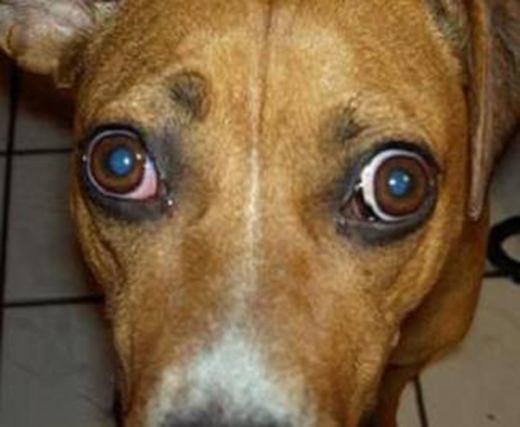
Creepy, right? Imagine if that were your dog.
When the vet is stumped
Ace’s vet took a look at him that Monday and did not know what was wrong. She said she had never seen anything like it, assumed it was some sort of allergy and ended up sending us home with some eye drops.
After a day or two, it was obvious the drops weren’t helping.
So, back to the vet.
Consulting with an eye specialist
This time, Ace’s vet had done as much research as she could on the issue and had spoken with a canine eye specialist who lived 200 miles away. I consulted with the specialist over the phone as well, and she was certain my dog had extraocular myositis.
This is what I learned about extraocular myositis from her:
- it is very rare but most common in Golden Retrievers and other retrieving breeds
- dogs are most likely to develop the problem at the age of 12 to 24 months
- a likely cause is an allergic reaction of some sort; dogs that get it have usually had other allergies throughout their lives
- many of the dogs that get it tend to have it a second or third time, but rarely again after that
All of the above were true for my dog.
Treating extraocular myositis in dogs
We treated Ace’s condition with prednisone to decrease the swelling. His eyes went back to normal in about two weeks, but I slowly weaned him off the prednisone over the next few months.
The side effects he experienced from the prednisone included extreme hunger and thirst, decreased energy and a very visible decrease in muscle mass.
Overall, I learned there is not a lot of information on why extraocular myositis occurs, but it was nice to know the issue was not life-threatening and not all that serious.
It just looks bad!
I never did figure out what initially caused my dog’s eyes to flare up. The vet said it could’ve been an allergic reaction to anything; I guess I’ll never know.
I hope none of your dogs ever have to deal with extraocular myositis, but if they do, it helps to know the problem looks much worse than it really is. And thankfully, it is fairly easy and inexpensive to treat.
My dog did not experience any permanent damage to his eyes, and once he was off the prednisone, he quickly rebuilt his muscle mass.
If you have any questions about extraocular myositis, feel free to reach out and I can share more about my dog’s experience.
Of course, I’m not a vet. For diagnosis and treatment, you’ll want to talk with a professional.
by Lindsay Stordahl of ThatMutt.com
Extraocular Myositis In Dogs Causes and Triggers
Extraocular myositis (EOM) is a rare inflammatory condition. It primarily affects the muscles that control eye movement, leading to sudden bulging of the eyes. While the exact cause is unknown, EOM is likely autoimmune in nature.
Immune-Mediated Reaction
(Primary Cause)
Extraocular Myositis in dogs is typically an autoimmune disorder where the body’s immune system mistakenly produces antibodies that attack specific proteins (antigens) unique to the extraocular muscles.
This leads to inflammation and swelling, restricting eye movement and causing the characteristic “bug-eyed” appearance. It’s not painful but can impair vision mechanically. This immune response is idiopathic (unknown origin) in most cases, though stress or hormonal changes may play a role. Early immunosuppressive treatment (e.g., prednisone) often resolves it, but relapses occur in 20-30% of dogs.
Infections
In some instances, an infection invading the muscle tissue can trigger immune response leading to EOM.
Common culprits include protozoal parasites like Neospora caninum (from contaminated food/water) or Toxoplasma gondii (from raw meat or cat feces exposure). Bacterial or viral infections are rarer but possible.
If they suspect an infection, your vet will for these via bloodwork or PCR—treating the underlying pathogen (e.g., with antibiotics/antiprotozoals) alongside anti-inflammatories is key.
Cancer
Rarely, extraocular myositis in dogs may be linked to cancer where the tumor triggers a violent immune reaction that cross-reacts with eye muscles (paraneoplastic syndrome).
This is more common in older dogs with malignancies like lymphoma or hemangiosarcoma. Symptoms might include systemic signs like weight loss or lethargy. Diagnosis requires full-body imaging (e.g., ultrasound/CT) to identify tumors—treating the cancer often resolves the myositis, but prognosis depends on the malignancy stage.
Genetic Predisposition
Certain breeds appear genetically susceptible, suggesting a hereditary component.
Young (6-18 months), large-breed dogs like Golden Retrievers, German Shepherds, Labrador Retrievers, and Shih Tzus are susceptible, possibly due to breed-specific immune traits or muscle anatomy. For example, Golden Retrievers may have a higher incidence linked to polymyositis (multi-muscle inflammation).
If your dog is in these breeds, annual eye checks and genetic screening (e.g., for autoimmune markers) can aid early detection. Cross-breeds with these lineages may also be at risk.
Other potential triggers include vaccinations or environmental allergens in sensitive dogs, though evidence is limited. Always note sudden eye changes and consult an ophthalmologist. EOM is treatable if caught early, but delays can lead to chronic issues or vision loss.
Prednisone is the standard treatment, but new alternatives include immunosuppressants like azathioprine for steroid-intolerant dogs. Taper slowly to avoid relapse; monitor side effects with regular checkups.
When Swollen Eyes May NOT Be EOM

Serious conditions that can cause similar appearances include:
- glaucoma
- retrobulbar abscess
- eye tumors
- foreign body behind the eye
- orbital trauma
- severe infections
That’s why you should treat sudden eye swelling as an emergency until proven otherwise.
Extraocular Myositis Breed-Specific Notes
Golden Retrievers and Labrador Retrievers
Goldens and Labradors are most susceptible to EOM. That is possibly linked to immune genetics—watch puppies for early swelling; related to masticatory muscle myositis in some lines.
Other Large Breeds
(e.g., Dobermans, Weimaraners, German Shepherds)
Higher incidence; monitor for polymyositis overlap (multiple muscle inflammation).
Mixed Breeds
Can occur if heritage includes predisposed breeds—genetic testing (e.g., for autoimmune markers) may help predict risk.
Small Breeds
Extraocular myositis is rare in small breeds. If you observe bulging eyes in your small breed dog, your veterinarian needs to rule out an infection—smaller eye sockets may amplify bulging.
EOM predominantly affects young (12-24 months) large/retrieving breeds, likely due to genetics—add after symptoms:
Extraocular Myositis In Dogs FAQ
Immune-mediated inflammation of eye muscles, likely allergy-triggered—common in young large breeds.
Non-painful bulging eyes disrupting vision (e.g., bumping objects)—whites swell first.
Not if isolated, but sudden bulging needs immediate vet to rule out glaucoma/tumors.
By eye specialists via exam/bloodwork—often after general vet referral.
Prednisone taper over months; monitor side effects like hunger/thirst.
Yes, 2-3 times typically—long-term management for chronic cases.
Related articles:
Bulging Eyes in Dogs: When Your Dog’s Bulging Eyes Are Not Normal, And You Should Be Concerned
A Primer on Glaucoma in Dogs
Retrobulbar Abscess in Dogs: Holly’s Bulging Eye
Further reading:
Canine Extraocular polymyositis
Thank you so much for sharing your story! This is the exact experience I am currently having – including my vet being stumped! I have a 9 month old lab and she is currently dealing with this. She is on day 3 of prednisone and I honestly cannot tell if her eyes are getting better. Her symptoms were very subtle Sunday night and slowly became more prominent – I got her in to the vet on Tuesday morning, so I didn’t wait very long!
Everything I have read says that it can take 1-2 weeks to go back to normal. When did you start seeing improvement after your dog started the prednisone?
Was there anything you were told to avoid? I particularly worry about being out in the sun and playing with other dogs due to her eyes being vulnerable.
Any help is appreciated! I have had dogs my entire life and nothing has been so unsettling and heartbreaking as this!
My dog is experiencing this same thing since last Thursday. We have had her to the vet 4 times in less then a week.